In 2017, I wrote an article called, "Gastroparesis' Effects on Dental Health." Please read it, if you have not already, because it explains what is happening to my teeth as we speak.
This is an ongoing article. I will be updating it as I go, including pictures after surgery, and the end result so that people can see what this ordeal is like, in case they have to go through something similar. If anyone wants to share their experiences that they have regarding these surgeries, I would be glad to add them to my blog article. Just email them to me. This blog article will be updated over the next four to six months because I will be documenting my recovery from surgery as well as the second phase of having my implants put in once the bone heals around the temporary bridges. So, I am going to share with you what I am dealing with so far.
Here is the treatment plan for myself, that I went over with the oral surgeon, and this is for implants - which are more expensive than dentures. I wanted people to see how much it would cost for implants, but for me, and the way that I vomit, and how often I vomit, implants are more of a fit for me than dentures are.
This does NOT include the fees due by the prosthesis doctor:

I feel like I could buy a brand new car or put a down payment on another house. I got really depressed when I found out how much it would be, especially since I'm doing implants instead of dentures.
Let's be clear, I have no problems with dentures. However, given how much I throw up, an how often, the oral surgeon said that I would degrade the dentures due to stomach acid, and I told him I was scared they would fly out of my mouth and hit someone. So, we decided on implants. Even though they are expensive, they would save me so many dental bills in the future. If one breaks, they can pop it out and send it to the lab to fix it, and then have it put back into my mouth.
The team of doctors I have are doing the all in one option. They are going to pull all of my teeth at once and then out in temporary bridges.

I will be having my surgery on November 17, 2019. It will be a ten to twelve hour surgery. There will be the oral surgeon, prosthesis dentist, and an anesthesiologist because my airway is so narrow that they are going to intubate me.
According to Paper Mill Dentistry,


I do want to make a quick note and update: One of my best friends, and my co-host on my Podcast (we will really start podcasting and getting things together in the new year after my surgeries are done) told me about this website that will help you afford dental work and dentures if you cannot afford it. The website is: https://dentallifeline.org/
This is from their "About Me" section,
You can learn more about them on their Facebook Page: https://www.facebook.com/DentalLifeline/
They have a video that explains more about them here:
https://www.youtube.com/watch?v=jVo0hnLJXq8#action=share
This is an ongoing article. I will be updating it as I go, including pictures after surgery, and the end result so that people can see what this ordeal is like, in case they have to go through something similar. If anyone wants to share their experiences that they have regarding these surgeries, I would be glad to add them to my blog article. Just email them to me. This blog article will be updated over the next four to six months because I will be documenting my recovery from surgery as well as the second phase of having my implants put in once the bone heals around the temporary bridges. So, I am going to share with you what I am dealing with so far.
Here is the treatment plan for myself, that I went over with the oral surgeon, and this is for implants - which are more expensive than dentures. I wanted people to see how much it would cost for implants, but for me, and the way that I vomit, and how often I vomit, implants are more of a fit for me than dentures are.
This does NOT include the fees due by the prosthesis doctor:

 |
| Image Source: My email from my doctor |
I decided to go with implants because the oral surgeon said given my age, he would not recommend dentures. Plus, dentures will degrade with stomach acid, so I would end up buying several pairs of dentures over time that would end up costing what the implants would cost anyway. I cannot always tell when I am about to vomit, and since I vomit so violently, I may not have time to remove the dentures before doing so. I just felt like implants were the best choice for me, and even though they are more expensive, I think the extra cost is worth it. Plus, it will cut down on my dental costs overall, as I just need to go in for routine cleanings. If I chip an implant, they can take it out, take it to the lab, fix it, and put it back in.
I am going the all in four option. The oral surgeon is going to remove what's left of my teeth and then put in the temporary bridges. After the bones heal, in four to six months, I will begin phase two, where they will put in the implants. Until then, I have to eat soft foods. I cannot eat anything I cannot cut with a fork. Well, with Gastroparesis, I pretty much do that as it is, so it will not be a considerable diet change for me.
I feel like I could buy a brand new car or put a down payment on another house. I got really depressed when I found out how much it would be, especially since I'm doing implants instead of dentures.
Let's be clear, I have no problems with dentures. However, given how much I throw up, an how often, the oral surgeon said that I would degrade the dentures due to stomach acid, and I told him I was scared they would fly out of my mouth and hit someone. So, we decided on implants. Even though they are expensive, they would save me so many dental bills in the future. If one breaks, they can pop it out and send it to the lab to fix it, and then have it put back into my mouth.
The team of doctors I have are doing the all in one option. They are going to pull all of my teeth at once and then out in temporary bridges.
 |
| Image Sources: HERE |
I will be having my surgery on November 17, 2019. It will be a ten to twelve hour surgery. There will be the oral surgeon, prosthesis dentist, and an anesthesiologist because my airway is so narrow that they are going to intubate me.
 | |||
| Image Source: HERE |
According to Paper Mill Dentistry,
"
Dental implants

Dental implants have been used to replace missing teeth since the 1960’s, but in the past 20 years their use has become routine. Dental implants are used to support crowns to replace one or more missing teeth, bridges that replace a larger span of missing teeth, or even dentures to replace all the missing teeth in a jaw. The implants are manufactured from titanium, a very safe metal that is compatible with the body and routinely used in orthopedic surgery to stabilize fractures and replace knees and hips. There is over 45 years of clinical evidence to show that dental implants are a safe and convenient way to replace lost teeth with natural-looking results.What are the advantages of dental implants?
Dental implants have a number of important advantages over conventional crowns, bridges and dentures:
- Dental Implants look and feel like natural teeth and DO NOT DECAY!
- Implants function in the same way as natural teeth.
- Healthy adjacent teeth do not have to be filed down to act as supports for the missing tooth or teeth. This means that they are less likely to need root canals.
- Dental implant maintains the jaw bone that usually atrophies after tooth extraction. Chewing forces are transmitted through the implant to the bone and stimulate the natural process of bone remodeling.
- Dental Implants helps preserve a good facial appearance.
- Dental implants provide anchorage for removable dentures.
- Dental implants prevent dentures from dislodging during chewing and speaking.
What does a dental implant consist of?
A dental implant is a specially machined titanium screw which is inserted into a prepared site in the jaw bone acting as a replacement root for the missing tooth. A special connecting part called an abutment is attached to the implant to which the new replacement tooth (crown) or teeth (bridge or denture) are anchored.
How do dental implants Heal?
During healing, the titanium surface of the implant fuses with the surrounding bone, in a process known as osseointegration, which can take about 3-6 months. After this time, the implant is stable enough to support one or more false teeth.
Who is a candidate for dental implant?
Dental implants are suitable for almost anyone who has lost one or more teeth and would like to restore their appearance or chewing ability. To obtain dental implant treatment; your mouth must be healthy, and with no untreated active periodontal (gum) disease. If implants are fitted in the presence of active periodontitis, there is a danger that an infection will develop around the implant, which will lead to its failure and loss. Your oral hygiene must be adequate before implants are placed, because the long-term success of implants depends on good oral hygiene leading to good plaque control. During and after treatment is completed, you must attend regular follow-up appointments so that the implants are checked and monitored in an effort to monitor your healing and plaque control in an effort to prevent any complications at an early stage.
When are dental implants not suitable treatment?
Dental implant therapy may not be feasible if the jaw bone is not sufficiently thick to accommodate implants and bone grafting is not possible to achieve a proper site for implant placement. Uncontrolled diabetics and patients with untreated periodontitis are at a higher risk of complications due to infection or poor healing; therefore increasing the risk of implant failure. However, once the diabetes is under control, their periodontal condition treated and their home care has improved these individuals may also benefit from dental implant treatment.
Image Source: HERE

What does implant treatment involve?
Dr. Schwartz will conduct a thorough examination of your mouth along with conventional 2D radiographs of your jaws to assess the shape and condition of your bone and locate the positions of possible implant sites in relation to important structures, such as nerves and the sinus cavities. Once the exam and preliminary radiographs have been performed, Dr. Schwartz, will discuss with you the potential treatment options for your individual needs and desires. A 3D computed tomography (CT) scan is used in most cases to plan the final treatment plan.
- Examination & Imaging
Implant placement surgery will be carried out using either a one-stage or two-stage procedure, depending on your particular clinical circumstances. In either case, the surgery involves making a small incision in the gum to expose the bone and using a special drills to shape the bone into an implant receptor site.
- Implant Placement and Healing
In the one-stage approach, the implant is inserted into the prepared bone and an attachment called a healing cap, which protrudes through the gum, is attached to the implant. The healing cap is removed after a 4-6 month healing period to test the stability of the implant in the bone and confirm the osseointegration of the implant and the bone. If osseointegration is confirmed, you will be scheduled to begin the restorative process.
In the two-stage approach, a cover screw is placed flush over the top of the implant and the gum is sewn up over it for the 4-6 month healing period. A second minor procedure is needed to uncover the implant through a small incision in the gum. Once the implant is uncovered the stability of the implant in the bone is tested to confirm the osseointegration of the implant and the bone. If osseointegration is confirmed, a healing collar will be attached to the implant and the gum tissue allow to heal around it for for a few weeks in preparation to begin the restorative phase.
After the implant to bone healing has been confirmed the restorative phase of treatment will commence by taking new impression of your mouth and the implant(s). The models fabricated from the impressions will be used to make a replica model of your teeth and implants on which the dental technician will construct your new prosthetic teeth.
- Restorative Phase and Impressions
Fitting your new prosthetic teeth is the final step in the dental implant treatment. The new teeth, crowns and /or bridges will be cement or screwed on to the abutments or implants and their appearance, fit and function will be assessed and the necessary adjustments will be made to ensure that your top and bottom teeth work together comfortably. A post insertion appointment will allow us to make sure that the implants are stable and functioning well, and that you are comfortable with the bite of the new restorations.
- Fitting of the prosthetic teeth - crowns or bridges
What is bone grafting?
Bone grafts are very common procedure in conjunction with dental implant treatment or in preparation for it. The purpose is to increase the width and or height of the jawbone to achieve an adequate implant site or to fill bony voids after implant(s) have been placed. Depending on the bone graft used a healing period of 4-6 months is necessary prior to placing implants into the grafted site. There are four types of bone grafts depending on their source.
- Autogenous - this is your own bone that is surgically removed body. Typically, the bone is harvested from the hip, as it is a good source of marrow which contains many bone cells.
- Allografts - this is donated human bone taken from a ‘bone bank’ and work in the same way as autogenous grafts.
- Xenografts - this is bone from an animal donor typically cows acting as the main source (bovine bone). The bovine bone in the graft is replaced by your own bone tissue over time.
- Alloplasts - this is are synthetic bone substitutes that are chemically similar to human bone. These grafts act as a sort of framework for new natural bone formation and may be replaced by natural bone (resorbable alloplasts) or retained (non-resorbable alloplasts).
How long will my implant last?
Dental implant have the potential to last you a lifetime. Dental implants have been used successfully for many decades and studies show a 95% success rate. With good oral hygiene and maintenance, they can function for many years. To help increase the lifespan of dental implants the following recommendations must be followed: Avoid smoking, continue with a very thorough oral hygiene programme at home and attend regular cleaning visits at our office for careful inspection of your implant, teeth and gums. This will allow you to have your implant and teeth professionally cleaned and enable any problems to be dealt with promptly before they threaten the stability of your implant.What might cause an implant to fail?
Assuming there have been no problems with the healing process after implant placement, the most likely cause of failure is inadequate oral hygiene. If tooth cleaning is poor, bacteria will build up on the implant surface and cause mucositis, an inflammatory process of the mucous membrane surrounding the implant. If left untreated, mucositis can progress to a more dangerous condition called peri-implantitis, in which the inflammatory process spreads to the bone around the implant and bone loss around the implant will ensue. If left untreated, enough bone will be lost compromising the stability of the implant until it becomes loose."
My teeth are in horrible shape due to the stomach acid I vomit up on a daily basis. I am so self conscious that I am scared to smile or even talk, and when I talk, I am scared to open my mouth too wide or too much so that people can see what is left of my teeth. However, I wanted to document everything in my blog so that other people going through this do not feel like they are alone. I wish that when I was first diagnosed, that the effect of the vomiting would have on my teeth. And yes, when I vomit, I do wash my mouth out with water, but stomach acid is very corrosive. I even used prescription mouthwash given to me by my dentist, but it was not enough to save my teeth. When my dentist told me I had no teeth left to save, I cried my eyes out. I got so depressed. He referred me to a wonderful team of doctors who are going to fix my smile for me so that I never have to worry about this again. As you can see below, the state of my teeth currently.


 |
| Image Sources: Self |
Here are some images from the dental prosthesis doctor that I am working with to show you the upper and lower jaw implants and how they take four screws to screw them in on the top and additionally, on the bottom of the jaw.

 | ||||
| Image Source: HERE |
I will be keeping this blog article updated as I go. My surgery, like I said, is on the 17th. They are doing it all at once, so I am probably going to be in a lot of pain but I will document as I go so that those who are thinking about getting dentures or implants because of gastroparesis, the stomach acid, and everything else. I just do not want anyone to be embarrassed or self conscious, although I know it is hard not to be, because you have a chronic illness you cannot control. However, fixing your oral health may help to fix your overall health.
According to the Mayo Clinic,
"Oral health: A window to your overall health
Your oral health is more important than you might realize. Learn how the health of your mouth, teeth and gums can affect your general health.
By Mayo Clinic Staff
Did you know that your oral health offers clues about your overall health — or that problems in your mouth can affect the rest of your body? Protect yourself by learning more about the connection between your oral health and overall health.
What's the connection between oral health and overall health?
Like other areas of the body, your mouth teems with bacteria — mostly harmless. But your mouth is the entry point to your digestive and respiratory tracts, and some of these bacteria can cause disease.
Normally the body's natural defenses and good oral health care, such as daily brushing and flossing, keep bacteria under control. However, without proper oral hygiene, bacteria can reach levels that might lead to oral infections, such as tooth decay and gum disease.
Also, certain medications — such as decongestants, antihistamines, painkillers, diuretics and antidepressants — can reduce saliva flow. Saliva washes away food and neutralizes acids produced by bacteria in the mouth, helping to protect you from microbes that multiply and lead to disease.
Studies suggest that oral bacteria and the inflammation associated with a severe form of gum disease (periodontitis) might play a role in some diseases. And certain diseases, such as diabetes and HIV/AIDS, can lower the body's resistance to infection, making oral health problems more severe.
What conditions can be linked to oral health?
Your oral health might contribute to various diseases and conditions, including:
Certain conditions also might affect your oral health, including:
- Endocarditis. This infection of the inner lining of your heart chambers or valves (endocardium) typically occurs when bacteria or other germs from another part of your body, such as your mouth, spread through your bloodstream and attach to certain areas in your heart.
- Cardiovascular disease. Although the connection is not fully understood, some research suggests that heart disease, clogged arteries and stroke might be linked to the inflammation and infections that oral bacteria can cause.
- Pregnancy and birth complications. Periodontitis has been linked to premature birth and low birth weight.
- Pneumonia. Certain bacteria in your mouth can be pulled into your lungs, causing pneumonia and other respiratory diseases.
Other conditions that might be linked to oral health include eating disorders, rheumatoid arthritis, certain cancers and an immune system disorder that causes dry mouth (Sjogren's syndrome).
- Diabetes. By reducing the body's resistance to infection, diabetes puts your gums at risk. Gum disease appears to be more frequent and severe among people who have diabetes.
Research shows that people who have gum disease have a harder time controlling their blood sugar levels. Regular periodontal care can improve diabetes control.
- HIV/AIDS. Oral problems, such as painful mucosal lesions, are common in people who have HIV/AIDS.
- Osteoporosis. This bone-weakening disease is linked with periodontal bone loss and tooth loss. Certain drugs used to treat osteoporosis carry a small risk of damage to the bones of the jaw.
- Alzheimer's disease. Worsening oral health is seen as Alzheimer's disease progresses.
Tell your dentist about the medications you take and about changes in your overall health, especially if you've recently been ill or you have a chronic condition, such as diabetes.
How can I protect my oral health?
To protect your oral health, practice good oral hygiene daily.
Also, contact your dentist as soon as an oral health problem arises. Taking care of your oral health is an investment in your overall health."
- Brush your teeth at least twice a day with a soft-bristled brush using fluoride toothpaste.
- Floss daily.
- Use mouthwash to remove food particles left after brushing and flossing.
- Eat a healthy diet and limit food with added sugars.
- Replace your toothbrush every three months or sooner if bristles are splayed or worn.
- Schedule regular dental checkups and cleanings.
- Avoid tobacco use.
According to the Dental Health Foundation,
"Links between oral & general health
The Mouth-Body Connection
Oral health is essential to general health and well-being at every stage of life. A healthy mouth enables not only nutrition of the physical body, but also enhances social interaction and promotes self-esteem and feelings of well-being. The mouth serves as a 'window' to the rest of the body, providing signals of general health disorders. For example, mouth lesions may be the first signs of HIV infection, aphthous ulcers are occasionally a manifestation of Coeliac disease or Crohn’s disease, pale and bleeding gums can be a marker for blood disorders, bone loss in the lower jaw can be an early indicator of skeletal osteoporosis, and changes in tooth appearance can indicate bulimia or anorexia. The presence of many compounds (e.g., alcohol, nicotine, opiates, drugs, hormones, environmental toxins, antibodies) in the body can also be detected in the saliva.
Oral conditions have an impact on overall health and disease. Bacteria from the mouth can cause infection in other parts of the body when the immune system has been compromised by disease or medical treatments (e.g., infective endocarditis). Systemic conditions and their treatment are also known to impact on oral health (e.g., reduced saliva flow, altered balance of oral microorganisms).
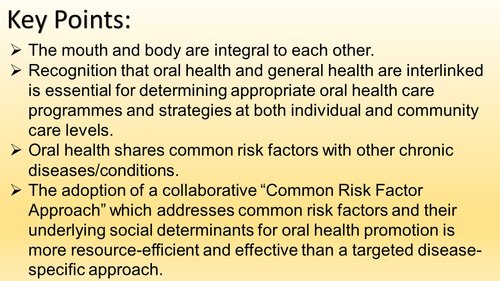
Periodontal disease has been associated with a number of systemic conditions. Though the biological interactions between oral conditions such as periodontal disease and other medical conditions are still not fully understood, it is clear that major chronic diseases – namely cancer and heart disease – share common risk factors with oral disease. Recognition that oral health and general health are interlinked is essential for determining appropriate oral health care programmes and strategies at both individual and community care levels. That the mouth and body are integral to each other underscores the importance of the integration of oral health into holistic general health policies and of the adoption of a collaborative 'Common Risk Factor Approach' for oral health promotion.
The Common Risk Factor Approach
Traditionally, oral health promotion has focused on the care of the teeth and gums, in isolation from other health programmes.
The Common Risk Factor Approach (CRFA) to health promotion takes a broader perspective and targets risk factors common to many chronic conditions and their underlying social determinants.
The key concept of this approach is that concerted action against common health risks and their underlying social determinants will achieve improvements in a range of chronic health conditions more effectively and efficiently than isolated, disease-specific approaches. Adoption of a common risk factor approach is more resource-efficient than a targeted disease-specific approach because:
The common risk factor approach provides a rationale for developing multi-sectoral healthy alliances between health professionals, statutory, voluntary and commercial bodies and the general public. It recognises that engendering lasting changes in individual 'lifestyle' behaviours requires supportive social, economic and political environments.
- most chronic diseases have multiple risk factors
- one risk factor can impact on several diseases
- some risk factors cluster in groups of people
- risk factors can interact – in some instances synergistically – with each other.
Common Risk Factors for Oral Health
Oral disease is the most widespread chronic disease, despite being highly preventable. The common risk factors that oral disease shares with other chronic diseases/conditions are:
– Risk factor for dental caries, coronary heart disease, stroke, diabetes, cancers, obesity
- Diet
– Risk factor for oral and other cancers, periodontal disease, coronary heart disease, stroke, respiratory diseases, diabetes
- Tobacco smoking/chewing
– Risk factor for oral and other cancers, cardiovascular disease, liver cirrhosis, trauma
- Alcohol consumption
– Risk factor for periodontal disease and other bacterial and inflammatory conditions
- Hygiene
– Risk factor for trauma, including dental trauma.
- Injuries
– Risk factors for periodontal disease and cardiovascular disease
- Control & Stress
– Independent risk factor as well as underlying determinant of other risk factors.
- Socio-economic status
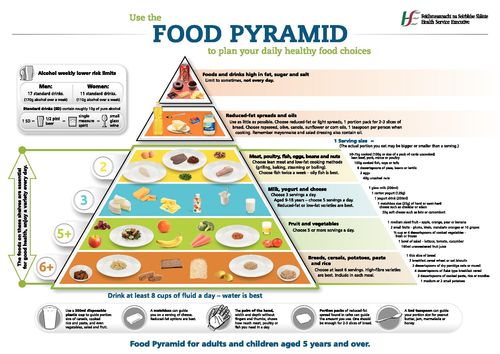
Image for Food Pyramid Diet
Diet is a risk factor for dental caries, coronary heart disease, stroke, diabetes, cancers and obesity.
Diet – the foods and drinks we consume to nourish our body – and our eating habits have an important influence on our health and well being. A good diet provides the body with the appropriate quantity and quality of nutrients it requires to sustain health. Deficiency diseases such as anaemia and osteoporosis result from the inadequate intake of essential specific nutrients (undernutrition). Overeating or excessive intake of nutrients (overnutrition) leads to obesity, a recognised major health risk factor.
Obesity is a serious problem in Ireland: in 2007, 25% of adults (24% of men; 26% of women) were obese; in 2002, 23% of boys and 28% of girls were either overweight or obese. Being overweight and obese increases the risk of coronary heart disease, stroke and Type 2 diabetes.
Dietary guidelines in Ireland are based on the Food Pyramid published by the Health Promotion Unit (www.healthpromotion.ie ) of the Department of Health. The Food Pyramid is designed to help people to eat a balanced diet combining several different types of food in the right amounts. The 'top shelf' of the pyramid represents foods high in fat, sugar and salt which are not essential for health and which should be used sparingly (maximum 1 daily serving); the 'bottom shelf' represents foods high in carbohydrates (e.g., breads, cereals and potatoes) which should comprise the bulk of our diet (i.e., 6+ daily servings). A survey of dietary habits of the Irish population (SLÁN 2007) found that only 14% of all adults surveyed (13% of men; 16 % of women) complied with the 'top shelf' recommendation to use foods high in fat, sugar and salt sparingly.
The top shelf of the Food Pyramid is of particular relevance to oral health as high consumption of foods/drinks containing added sugars is a direct cause of dental caries. The oral health message to restrict consumption of foods/drinks containing added sugars to mealtimes complements the healthy heart message to reduce consumption of foods high in oils and fats.
Studies also show that eating more fruits and vegetables can have a protective influence against cancers and systemic inflammatory (including periodontal) diseases."
Be sure to check with your doctor concerning diet, because the Gastroparesis Diet is a bit different from normal diets. If you are newly diagnosed with Gastroparesis, just keep in mind there are a lot of secondary issues that come with it that you might not be aware of at the time, because you are overwhelmed with just being diagnosed. Gastroparesis can affect the body in many different ways. I plan on writing an article about secondary effects it has on the body in addition to what I have already written. I just want people to be informed and though I am not a doctor, and this is NOT a substitute for a doctor's advice, I do recommend keeping a journal for your personal Gastroparesis and write it as detailed as possible. I would also recommend writing any questions you may think of for the doctor as you go so that you do not forget to ask them your questions when you go in to see them.
I do want to make a quick note and update: One of my best friends, and my co-host on my Podcast (we will really start podcasting and getting things together in the new year after my surgeries are done) told me about this website that will help you afford dental work and dentures if you cannot afford it. The website is: https://dentallifeline.org/
This is from their "About Me" section,
"Dental Lifeline Network
A 501(c)(3) nonprofit organization, founded in 1974, that nationally provides access to dental care and education for people who cannot afford it and:
have a permanent disability or
who are elderly: age 65 or older or
who are medically fragile"
You can learn more about them on their Facebook Page: https://www.facebook.com/DentalLifeline/
They have a video that explains more about them here:


