Find us on Google+ Gastroparesis: gi tract

Copyright

“You agree that you will not modify, copy, reproduce, sell, or distribute any content in any manner or medium without permission."
Showing posts with label gi tract. Show all posts

Wednesday, April 10, 2019

Researchers Develop A Wearable Twenty-Four Hour GI Tract Monitor

My friend Kendall brought this to my attention. I thought it was an interesting monitoring system, and less invasive than other GI tests. I do not know much about this topic, but I was happy to learn about it as I go. However, there will be a lot of citing, since I have no personal experience with this test. The twenty-four hour GI Tract Monitor articles were released last year, but without Kendal, I would not be aware of this test. So, I want to thank her again.


According to MobiHealthNews,


"UCSD Researchers Develop Wearable, 24-hour GI tract monitor
By Laura LovettMarch 26, 2018


Good news for Winnie-the-Pooh — a new wearable device may be able to track exactly what that rumble in his tummy is.

Now a wearable device, developed by researchers at the GI Innovation Group out of the University of California San Diego, can track electrical activity in the stomach over a 24-hour period. The device works similarly to how an ECG would work for the heart, but instead it monitors the electrical activities of gastrointestinal tract.

In a recent study published by Scientific Reports, researchers found that the device was able collect data comparable to the clinical gold-standard, which is currently an invasive procedure.

'Diseases of the gastrointestinal tract (stomach, intestines, etc) are one of the most common complaints in modern medicine,' Armen Gharibans, the paper's first author and a bioengineering postdoctoral researcher at the University of California San Diego, wrote to MobiHealthNews in an email. 'Oftentimes, symptoms cannot be attributed to a medical condition despite appropriate workup. These disorders fall under the umbrella of functional disorders and make up more than 50 percent of patient referrals to GI specialists. There is an unmet need for new technologies in gastroenterology, especially ones that can monitor the patient outside of the clinic since GI activity and symptoms can vary greatly day to day. We believe the technology we're developing can facilitate better understanding of the pathophysiology of these functional GI disorders and lead to novel and more targeted therapies.'

Right now there are limited resources for monitoring GI conditions, forcing many to go to specialized centers for treatment, according to the study.

The new device is made up of a 3D-printed box that holds the electronics and battery and connects to 10 wearable electrodes. It works as an electrogastrogram (EGG) monitor, and was made from store-bought electrodes that are typically used in ECGs, according to a statement. EGGs often have technological issues including inconsistent results from a single-channel measurement and signal artifacts, which can make it difficult to interpret, according to the study. Researchers aimed to remedy this by using a multi-channel system and artifact removal signal processing methods.

Researchers also developed a smartphone app to where patients can log their activity, bowel movements, sleep, and symptoms. The data from smartphone is then synced with the device data for real-time feedback to the users, according to Gharibans.

In the study, 11 children and one adult tested the device. The children included three males and eight females, aged seven to 17 years with a median BMI of 19. Researchers said that they studied the device on more girls than boys because indigestion is more common among females.

The study participants underwent an antroduodenal manometry where a flexible catheter placed in the participant's nose monitors pressure in the antrum of the stomach. This procedure is commonly used to study the GI tract.

Simultaneously, the participants were fitted with the EGG device, with the electrodes were placed over the stomach. Researchers then recorded the results of both the manometry and the EGG results, and found that their device yielded an increase of 0.56 in the mean correlation coefficient between EGG and the manometry method.

'Our approach is noninvasive, easy to administer, and has promise to widen the scope of populations with GI disorders for which clinicians can screen patients, diagnose disorders, and refine treatments objectively,' the researchers wrote.

The GI Innovation Group is continuing to work on the product but are still in the research phase, which includes collecting more data from patients, understanding limitations, and improving the analysis method, according to Gharibans.

'We would like to eventually bring it to market, so we are actively exploring business opportunities and applying for small business grants to allow us to further develop and miniaturize the technology,' Gharibans wrote.

In the future, Gharibans said the device could monitor a number of GI-related issues, including some very common conditions that impact a large subset of the US population.

'Since our technology is focused on the stomach, the two main GI conditions that this could really help monitor are functional dyspepsia and gastroparesis,' Gharibans wrote. 'Functional dyspepsia (i.e., chronic upset stomach) is reported by up to 20 percent of children and adolescents and is predicted to affect 20 percent to 40 percent of all the US population at least once in their lifetime. Gastroparesis, characterized by delayed gastric emptying in the absence of a mechanical obstruction, affects four percent of the US population, including 70 percent of Parkinson’s patients and 50 percent of diabetes patients. Both of these conditions are under-diagnosed and under-managed'"


Image Source: HERE


According to Science Daily,


"Researchers have developed a wearable system to monitor stomach activity that performs as well as current state of the art methods but can be used outside of a clinical setting. The system also comes with an app that allows patients to log their meals, sleep and other activities.

Credit: University of California San Diego


A team of researchers has developed a wearable, non-invasive system to monitor electrical activity in the stomach over 24 hours -- essentially an electrocardiogram but for the gastro-intestinal (GI) tract.

Applications include monitoring GI activity for patients outside of a clinical setting, which cuts down costs. Monitoring for longer periods of time also increases the likelihood of capturing abnormal events.

Researchers detail their findings in the March 22 issue of Nature's open access journal Scientific Reports.

The team tested the device, a 3D printed portable box connected to 10 small wearable electrodes, on 11 children and one adult volunteer. They found that data collected with the wearable system were comparable to data collected in the clinic with state-of-the-art methods, which are invasive -- including a catheter inserted through the patient's nose. They also found that the stomach's electrical activity changes not only around meals, but also during sleep, following its own circadian rhythm.

'We think our system will spark a new kind of medicine, where a gastroenterologist can quickly see where and when a part of the GI tract is showing abnormal rhythms and as a result make more accurate, faster and personalized diagnoses,' said Armen Gharibans, the paper's first author and a bioengineering postdoctoral researcher at the University of California San Diego.

Todd Coleman, the paper's corresponding author and a UC San Diego professor of bioengineering, agrees.

'This work opens the door accurately monitoring the dynamic activity of the GI system' he said. 'Until now, it was quite challenging to accurately measure the electrical patterns of stomach activity in a continuous manner, outside of a clinical setting. From now on, we will be able to observe patterns and analyze them in both healthy and unwell people as they go about their daily lives.'

Physicians involved with the study say the device meets an unmet clinical need.

'This will help us determine if the stomach is functioning properly during meals and -- most importantly -- when patients are experiencing symptoms such as nausea and belly pain,' said Dr. David Kunkel, one of the paper's co-authors and a gastroenterologist at UC San Diego Health.

The breakthrough was made possible because engineers and physicians came together to work on the problem, said Benjamin Smarr, one of the paper's co-authors and a chronobiologist at UC Berkeley.


Better algorithms

The researchers' biggest challenge was designing algorithms that recognize and boost the stomach's electrical signals amid noise and artifacts. This is especially difficult to do because the stomach's electrical signals are 10 times weaker than the heart's, making them harder to capture and analyze.

Researchers harnessed the signal processing expertise in Coleman's research group to develop a sophisticated algorithmic pipeline that can clean up the data and separate out abdominal muscle activity (for example when a person walks), heart beats and gastric activity, into different bands of signals that do not overlap. As a result, clinicians can examine each signal individually and compare it to others.


The device and testing

The device itself uses off-the-shelf electrodes used in electrocardiograms. The electronics and battery are encased in a 3D printed box and connected to the electrodes, which fit on a person's abdomen just over the stomach.

The researchers worked with Dr. Hayat Mousa and tested the device on 11 pediatric patients at Rady Children's Hospital in San Diego. These patients had been undergoing an invasive procedure called manometry, one of a couple clinical gold standards for objectively monitoring GI tract activity. The procedure requires using a catheter inserted through the nose to measure pressure at several points inside the stomach. Comparing the two methods showed that data collected by the wearable device was robust and reliable.

'I have been practicing pediatric gastroenterology and taking care of patients for 20 years,' Dr. Mousa said. 'The only method to assess gastrointestinal motility involves placing motility catheters in the GI tracts while kids are sedated or under general anesthesia. It has been a long journey discussing the benefits of doing such an invasive procedure with my patients and their families. My challenge has always been finding a test that offers a non-invasive assessment of the enteric nervous system and its connection with brain function.'

'The technique outlined in this paper is the best way to evaluate children with motility and functional GI disorders,' Dr. Mousa added. 'It provides the information without need for sedation and it offers the flexibility to monitor kids while they continue their daily activities. This procedure allows convenience without compromising accuracy. In addition, it offers the option to assess the brain-gut response to therapeutic interventions including biofeedback and neuromodulation.'

The system is currently paired with a smart phone app that allows patients to log their meals, sleep and other activities. The long-term goal is to design an app that would allow patients and physicians to see the data collected by the device in real time.

'This is analogous to going from switchboard operators straight to smart phones for gastroenterology,' Smarr said.

GI problems, such as delayed emptying of the stomach, are common in patients with diabetes and Parkinson's. This technology could improve the management of these conditions.

Healthy people could also benefit from using the device. For example, competitive athletes and their coaches could monitor GI activity to figure out the best time for meals, especially while traveling across different time zones. Pregnant women suffering from heartburn and other GI problems could use it to monitor the stomach's activity before, during and after meals, as would the elderly. '
'Changes to digestion and gastric health are hallmarks of two understudied processes: aging and pregnancy," UC Berkeley's Smarr said. 'One of our hopes is that this technology will allow us to quantify the changes that happen during these critical periods in life. They affect the vast majority of humanity, and will now be possible to study what's going on, and build predictive, personal medical applications based on getting ahead of bad changes.'

The research was funded by Larry Smarr, UC San Diego Professor in the Department of Computer Science and Engineering and founding director of the California Institute for Telecommunications and Information Technology (or Calit2), through his Harry E. Gruber endowed chair funds.


Story Source:

Materials provided by University of California - San Diego. Note: Content may be edited for style and length.


Journal Reference:

Armen A. Gharibans, Benjamin L. Smarr, David C. Kunkel, Lance J. Kriegsfeld, Hayat M. Mousa, & Todd P. Coleman. Artifact Rejection Methodology Enables Continuous, Noninvasive Measurement of Gastric Myoelectric Activity in Ambulatory Subjects. Scientific Reports, 2018 DOI: 10.1038/s41598-018-23302-9


Citation:

University of California - San Diego. 'A wearable system to monitor the stomach's activity throughout the day.' ScienceDaily. www.sciencedaily.com/releases/2018/03/180322134302.htm (accessed April 6, 2019)."


Image Source: HERE

Sunday, October 1, 2017

Thrush and Gastroparesis

Thrush is terrible. I have had it on my tongue and down my esophagus, and I'm not the only one. People in my support groups have had the same. I wanted to look up why this happens more frequently to Gastroparesis Warriors. I mean, I know why thrush happens. It is caused by an imbalance of good and bad bacteria in your body.


Image Credit: https://www.globalhealingcenter.com/natural-health/wp-content/uploads/2015/06/whatscandidaBLOG-300x200.jpg


According to Healthline (https://www.healthline.com/health/candida-esophagitis#outlook9,

"Esophageal Thrush (Candida Esophagitis)
Written by April Kahn and Rachel Nall
Medically Reviewed by Nancy Choi, MD on August 17, 2017


What is esophageal thrush?

Esophageal thrush is a yeast infection of the esophagus. The condition is also known as esophageal candidiasis.
Fungi in the family Candida cause esophageal thrush. There are about 20 species of Candida that can cause the condition, but it’s usually caused by Candida albicans.


Causes:


How does esophageal thrush develop?

Traces of the fungus Candida are normally present on the surface of your skin and within your body. Normally, your immune system can regulate these good and bad organisms in your body. Sometimes, though, a shift in the balance between the Candida and your healthy bacteria can cause the yeast to overgrow and develop into an infection.


Risk factors:


Who is at risk?

If you’re healthy, it’s unlikely you will develop this condition. People with compromised immune systems, such as those with HIV, AIDS, or cancer, and older adults are at a higher risk. Having AIDS is the most common underlying risk factor. According to the Centers for Disease Control and Prevention (CDC), 20 percent of all people with cancer develop the condition.

People with diabetes are also at an increased risk of developing esophageal thrush, especially if their sugar levels are not well controlled. If you have diabetes, there’s often too much sugar present in your saliva. The sugar allows the yeast to thrive. More importantly, uncontrolled diabetes also hurts your immune system, which allows for candida to thrive.

Babies who are born vaginally can develop oral thrush if their mothers had a yeast infection during delivery. Infants can also develop oral thrush from breastfeeding if their mother’s nipples are infected. Developing esophageal thrush this way is uncommon.
There are other risk factors that make someone more likely to develop this condition.


You’re more at risk if you:
smoke
wear dentures or partials
take certain medications, such as antibiotics
use a steroid inhaler for conditions like asthma
have a dry mouth
eat lots of sugary foods
have a chronic disease


Symptoms:


The symptoms of esophageal thrush include:

white lesions on the lining of your esophagus that may look like cottage cheese and may bleed if they’re scraped
pain or discomfort when swallowing
dry mouth
difficulty swallowing
nausea
vomiting
weight loss
chest pain

It’s also possible for esophageal thrush to spread to the inside of your mouth and become oral thrush.


Image Credit: https://www.globalhealingcenter.com/natural-health/wp-content/uploads/2015/06/whatscandidaBLOG-300x200.jpg


The symptoms of oral thrush include:

creamy white patches on the inside of the cheeks and on surface of the tongue
white lesions on the roof of your mouth, tonsils, and gums
cracking in the corner of your mouth
Breastfeeding moms can experience Candida infection of the nipples, which they can pass on to their babies.


The symptoms include:
especially red, sensitive, cracking, or itchy nipples
stabbing pains felt deep within the breast
significant pain when nursing or pain between nursing sessions


If you experience these conditions, you should watch your baby for signs of infection. While babies can’t say if they’re feeling bad, they may become more fussy and irritable. They can also have the distinctive white lesions associated with thrush.


Image Credit: https://image.slidesharecdn.com/candidiasis-120131033954-phpapp01/95/candidiasis-14-728.jpg?cb=1327986257


Diagnosis:


Esophageal thrush: Testing and diagnosis:

If your doctor suspects you might have esophageal thrush, they will do an endoscopic exam.
Endoscopic exam

During this exam, your doctor looks down your throat using an endoscope. This is a small, flexible tube with a tiny camera and a light at the end. This tube can also be lowered into your stomach or intestines to check the extent of the infection.


Image Credit: http://www.candidainstool.com/wp-content/uploads/2016/12/Candida-Esophagitis-3.jpg


Treating esophageal thrush:

The goals of treating esophageal thrush are to kill the fungus and prevent it from spreading.

Esophageal thrush warrants systemic antifungal therapy, and an antifungal medication, such as itraconazole, will likely be prescribed. This prevents the fungus from spreading and works to eliminate it from the body. The medication can come in a variety of forms, such as tablets, lozenges, or a liquid that you can swish in your mouth like mouthwash and then swallow.


Image Credit: http://images.slideplayer.com/34/10174302/slides/slide_42.jpg


If your infection is slightly more severe, you may receive an antifungal medication called fluconazole delivered intravenously in the hospital.

People with late-stage HIV might need a stronger medication, such as amphotericin B. Most importantly, treating the HIV is important for controlling the esophageal thrush.

If your esophageal thrush has compromised your ability to eat, your doctor may discuss nutritional options with you. This can include high-protein shakes if you can tolerate them or alternative feeding options, such as a gastric tube in severe situations.


Preventing esophageal thrush:

You can reduce your risk of developing esophageal thrush in the following ways:

Eat yogurt whenever you take antibiotics.
Treat vaginal yeast infections.
Practice good oral hygiene.
Go to your dentist for regular checkups.
Limit the amount of sugary foods you eat.
Limit the amount of foods you eat that contain yeast.


Even though those with HIV and AIDS are at greater risk for esophageal thrush, doctors rarely prescribe preventive antifungal medicines. The yeast could become resistant to treatments. If you have HIV or AIDS, you can reduce your risk of an esophageal thrush infection by taking prescribed antiretroviral therapy (ART) medications.


Future health complications:

The risk for complications after the development of esophageal thrush is higher in people with comprised immune systems. These complications include thrush that spreads to other areas of the body and an inability to swallow.

If you have a compromised immune system, it’s very important to seek treatment for thrush as soon as you notice symptoms. Thrush can easily spread to other parts of your body, including your:

lungs
liver
heart valves
intestines
By receiving treatment as quickly as possible, you can reduce the likelihood that thrush will spread.


Outlook for esophageal thrush:

Esophageal thrush can be painful. If it’s left untreated, it can become a severe and even life-threatening condition. At the first signs of oral thrush or esophageal thrush, talk to your doctor. Esophageal thrush is highly prone to spreading. The more areas of the body affected, the more severe the infection can be. Medications are available to treat esophageal thrush, including antifungal medicines. Prompt and careful treatment can reduce your pain and discomfort.


References:
Candida infection. (2014). http://www.oralcancerfoundation.org/complications/candida-infection.php
Candidiasis: (Thrush). (2014). http://www.aidsinfonet.org/fact_sheets/view/501
Oral thrush: Symptoms. (2014). http://www.mayoclinic.com/health/oral-thrush/DS00408/DSECTION=symptoms
Oropharyngeal/esophageal candidiasis (thrush). (2014). http://www.cdc.gov/fungal/diseases/candidiasis/thrush/definition.html
Copyright © 2005 - 2018 Healthline Networks, Inc. All rights reserved. Healthline is for informational purposes and should not be considered medical advice, diagnosis or treatment recommendations."


Image Credit:
https://cdn2.curejoy.com/content/wp-content/uploads/2017/04/Oral-Thrush_Internal-Causes-Of-Angular-Cheilitis-Due-To-Systemic_Other-Medical-Conditions.jpg>https://cdn2.curejoy.com/content/wp-content/uploads/2017/04/Oral-Thrush_Internal-Causes-Of-Angular-Cheilitis-Due-To-Systemic_Other-Medical-Conditions.jpg


According to Medical News Today (https://www.medicalnewstoda
y.com/articles/178864.php,

Oral Thrush: Causes, Symptoms, and Treatments
By Christian Nordqvist
Reviewed by University of Illinois-Chicago, School of Medicine


"Oral thrush, also known as oral candidiasis, is a yeast/fungi infection of the genus Candida that develops on the mucous membranes of the mouth.

It is most commonly caused by the fungus Candida albicans, but may also be caused by Candida glabrata or Candida tropicalis.

In this article, we will cover all aspects of oral thrush, including the causes, symptoms, and treatment.

Contents of this article:


Causes
Symptoms
Treatment
Risk factors
Diagnosis
Fast facts on oral thrush
Here are some key points about oral thrush. More detail and supporting information is in the main article.


Oral thrush is a common condition, but for most, it does not cause major problems

Individuals with a reduced immune system are worst affected by oral thrush

Oral thrush can occur more regularly after chemotherapy or radiotherapy to the head and neck

It is more common in people who are taking steroids, wear dentures, or have diabetes
The most obvious symptom of oral thrush is creamy or white-colored deposits in the mouth


What is oral thrush?


Oral thrush is caused by species of Candida fungus.

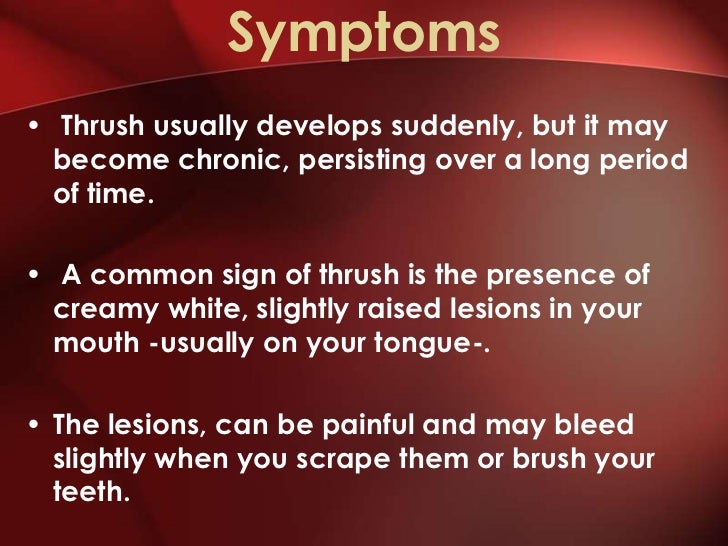
Oral thrush causes thick white or cream-colored deposits, most commonly on the tongue or inner cheeks. The lesions can be painful and may bleed slightly when they are scraped. The infected mucosa (membrane) of the mouth may appear inflamed and red.

Oral thrush can sometimes spread to the roof of the mouth and the back of the throat.

For the majority of individuals, oral thrush does not cause any serious problems. However, this is not the case for people with a weakened immune system, whose signs and symptoms may be much more severe.

People with poorly controlled diabetes, those taking steroids (especially long-term), as well as individuals who wear dentures, have a higher risk of developing oral thrush with more severe symptoms.

Long-term antibiotic therapy can increase the risk of developing oral thrush. Some medications, especially those that dry out the mouth, can cause oral thrush to develop. Oral thrush is more common among patients who receive chemotherapy or radiotherapy to the head and neck.

The outcome for oral thrush is generally very good. Most people respond well to treatment. However, oral thrush tends to reappear, especially if the causal factor (smoking, for instance) is not removed.


Image Credit: https://i.ytimg.com/vi/5JFURRsBo_8/hqdefault.jpg


Causes of oral thrush:

Tiny quantities of Candida fungus exist in various parts of our body, including the digestive system, skin, and mouth, causing virtually no problems to healthy individuals. In fact, C. albicans is carried in the mouths of up to 75 percent of the world's population.

However, people on certain medications, with reduced immune systems, or certain medical conditions are susceptible to oral thrush when C. albicans grows out control.


Symptoms of oral thrush:

Oral thrush in adults generally appears as thick, white or cream-colored deposits (spots) on the mucous membrane of the mouth (wet parts of the inside of the mouth).

The mucosa (mucous membrane) may appear swollen and slightly red. The spots may be raised. There may be discomfort or a burning sensation.

If the cream or white-colored deposits are scraped, bleeding may occur.

The white spots may join together to form larger ones, also known as plaques; these may then take on a grayish or yellowish color.

Occasionally, the affected area simply becomes red and sore, with no detectable white spots.

Individuals who wear dentures may have areas that are constantly red and swollen under a denture. Poor oral hygiene, or not taking the dentures out before going to sleep may increase the risk.


Oral thrush is sometimes divided into three groups based on appearance, although the condition can sometimes sit between categories:

A Doctor checks a patient's throat
Oral thrush is typically diagnosed after an oral examination.
Pseudomembranous - the classic and most common version of oral thrush.
Erythematous (atrophic) - the condition appears red raw rather than white.
Hyperplastic - also referred to as "plaque-like candidiasis" or "nodular candidiasis" due to the presence of a hard to remove solid white plaque. This is the least common variant; it is most often seen in patients with HIV.

There are a number of other lesions that can also appear with oral thrush. Sometimes, these lesions might be due to other types of bacteria that are also present in the area.


These can include:

Angular cheilitis - inflammation and/or splitting in the corners of the mouth
Median rhomboid glossitis - a large, red, painless mark in the center of the tongue
Linear gingival erythema - a band of inflammation running across the gums


Treatment of oral thrush:

Doctors will usually prescribe anti-thrush drugs, such as nystatin or miconazole in the form of drops, gel, or lozenges. Alternatively, the patient may be prescribed a topical oral suspension which is washed around the mouth and then swallowed.

Oral or intravenously administered antifungals may be the choice for patients with weakened immune systems. If treatment is not working, amphotericin B may be used; however, this will only be used as a last resort due to the negative side effects which include fever, nausea, and vomiting.


Risk factors for oral thrush:


Adult oral thrush is more likely to become a problem for the following groups:

People who wear dentures - especially if they are not kept clean, do not fit properly, or are not taken out before going to sleep.

Antibiotics - people who are on antibiotics have a higher risk of developing oral thrush. Antibiotics may destroy the bacteria that prevent the Candida from growing out of control.

Excessive mouthwash use - individuals who overuse antibacterial mouthwashes may also destroy bacteria which keep Candida at bay, thus increasing the risk of developing oral thrush.

Steroid medication - long-term use of steroid medication can increase the risk of oral thrush.

Weakened immune system - people with weakened immune systems are more likely to develop oral thrush.

Diabetes - people with diabetes, especially if it is poorly controlled, are more likely to have oral thrush.

Dry mouth - people with less than normal quantities of saliva (xerostomia) are more prone to oral thrush.

Diet - malnutrition predisposes people to oral thrush; this could be caused by a poor diet or a disease that affects the absorption of nutrients. In particular, diets low in iron, vitamin B12, and folic acid appear to affect infection rates.

Smoking - heavy smokers are more at risk, the reasons behind this are unclear.


Diagnosis of oral thrush:

In the vast majority of cases, the doctor can diagnose oral thrush by looking into the patient's mouth and asking some questions about symptoms.

The doctor may scrape some tissue from the inside of the mouth for analysis.

If the doctor believes the oral thrush is being caused by a medication or some other underlying cause, that cause must be dealt with. Treatments in such cases depend on the underlying cause.


References
Amphotericin B (intravenous route, injection route). (2015, December 1). Retrieved from http://www.mayoclinic.org/drugs-supplements/amphotericin-b-intravenous-route-injection-route/side-effects/drg-20061771

Awatif Y. Al-Maskari, Masoud Y. Al-Maskari, Salem Al-Sudairy. (2011, May). Oral manifestations and complications of diabetes mellitus. Sultan Qaboos University Medical Journal. 11(2): 179–186. Retrieved from https://www.ncbi.nlm.nih.gov/pmc/articles/PMC3121021/

François L. Mayer, Duncan Wilson, Bernhard Hube. (2013, February 15). Candida albicans pathogenicity mechanisms. Virulence. 4(2): 119–128. Retrieved from https://www.ncbi.nlm.nih.gov/pmc/articles/PMC3654610/

Oral thrush in adults. (2014, August 14). Retrieved from http://www.nhs.uk/Conditions/Oral-thrush---adults/Pages/Introduction.aspx

Oropharyngeal/esophageal candidiasis ("thrush"). (2014, February 2013). Retrieved from https://www.cdc.gov/fungal/diseases/candidiasis/thrush/

Treatments for oral thrush. (2014, August 14). Retrieved from http://www.nhs.uk/Conditions/Oral-thrush---adults/Pages/Introduction.aspx#treatment


I also found some natural recipes to help with thrush until you can see your doctor:

Image Credit: https://image.slidesharecdn.com/thrush-140605173056-phpapp02/95/thrush-11-638.jpg?cb=1401989495


I had a suspicion that my Gastroparesis was causing it, with all of vomiting, but had no idea that other chronic illnesses caused this. So, I think the constant vomiting of stomach acid brought on mine. It probably did through off my pH. I learned a lot of new things today and I hope it well help others.