The idea was suggested to me (by my MD) that a blog/diary might help me feel better by venting my frustrations and struggles with Gastroparesis. Also, I hope I can help others who may have the same thing through my own experiences.
For more information, please email: emilysstomach[at]gmail.com or follow on Twitter: http://twitter.com/emilysstomach or like us on Facebook: http://www.facebook.com/emilysstomach or Instagram: http://www.instagram.com/emilysstomach
Copyright
“You agree that you will not modify, copy, reproduce, sell, or distribute any content in any manner or medium without permission."
I have had several friends, all of whom suffer from Gastroparesis and other chronic illnesses, have stomach surgeries. Some of them have had Gastric Bypasses or Nissen Fludoplications (which, you can read my article and research about the Gastric Bypass and Sleeve here: https://www.emilysstomach.com/2017/06/gastric-bypass-sleeve-and-gastroparesis.html and you can read about the Nissen Fludoplication surgery here: https://www.emilysstomach.com/2017/06/nissen-fundoplication.html) but most have had complications from these surgeries where they needed to have a Gastrectomy. A Gastrectomy, according to UCSF,
"Gastrectomy
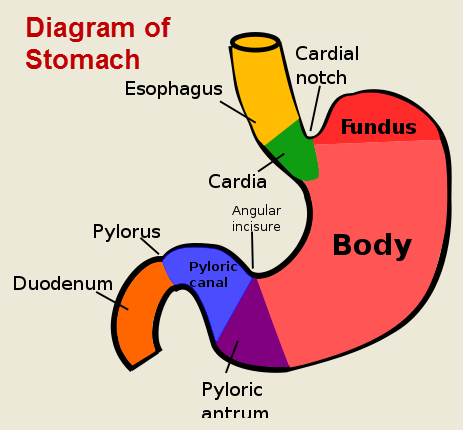
A gastrectomy is the surgical removal of all or part of the stomach. The stomach is a J-shaped organ in the upper abdomen. It is part of the digestive system, which processes nutrients ( vitamins, minerals, carbohydrates, fats, proteins, and water) in foods that are eaten and helps pass waste material out of the body.
Food moves from the throat to the stomach through a hollow, muscular tube called the esophagus. After leaving the stomach, partly-digested food passes into the small intestine and then into the large intestine.
Gastrectomy is performed for the following conditions:
Stomach Cancer
Bleeding Gastric Ulcers
Perforation (Hole) in the Stomach Wall
Benign Polyps
A partial gastrectomy is the removal of only part of the stomach. The remaining portion then continues with its digestive role. If the entire stomach is removed, the esophagus is connected directly to the small intestine, where digestion now begins. Patients must make significant dietary changes when a gastrectomy is performed.
For severe gastric ulcers involving the duodenum, the pylorus, the lower portion of the stomach, may be removed along with the all or part of the duodenum, the upper portion of the small intestine.
A Billroth procedure is then preformed. Where a sufficient portion of duodenum remains, a Billroth I is performed where the remaining stomach is reattached to the duodenum before the bile duct and pancreas ducts. If the stomach cannot be reconnected to the duodenum, a Billroth II is performed, in which an opening hole is made in the next section of the small intestine, the jejunum, and the stomach attached at that opening.
The pylorus is used to grind food and slowly release it into the small intestine. Its removal causes food to move more rapidly through the small intestine, often leading to gastric dumping syndrome, a condition treatable via change in diet."
This guide will help you prepare for your gastrectomy surgery at Memorial Sloan Kettering (MSK) and help you understand what to expect during your recovery. Read through this guide at least once before your surgery and then use it as a reference in the days leading up to your surgery. Bring this guide with you every time you come to MSK, including the day of your surgery, so that you and your healthcare team can refer to it throughout your care.
Your Stomach
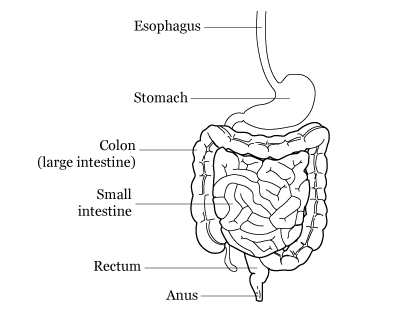
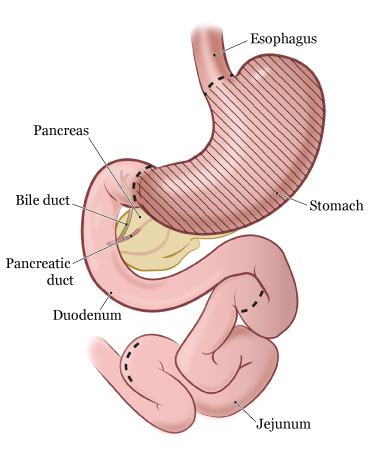
The stomach is an organ in your digestive system that helps to store and digest food. It is located between your esophagus (food pipe) and your small intestine (see Figure 1). The walls of your stomach are made up of muscles that churn and break down food into small pieces. Your stomach also produces acid that begins to break down or digest food.
Figure 1. The digestive system
When the food leaves your stomach, it moves into your small intestine. The first parts of your small intestine are the duodenum and the jejunum. Your food continues to be digested and absorbed in your small intestine.
Gastrectomy
Gastrectomy is a surgery that is done to treat cancer of the stomach. During the surgery, your surgeon may remove part or all of your stomach. There are several kinds of gastrectomies:
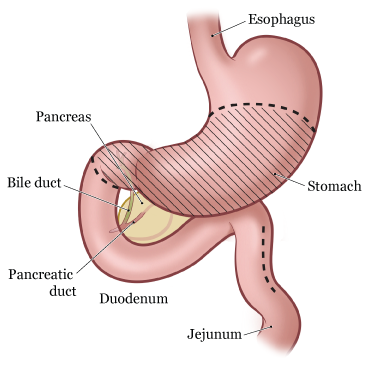
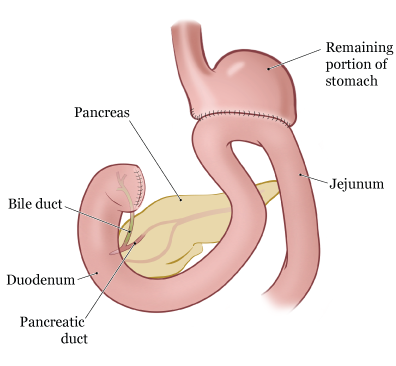
A subtotal gastrectomy includes removing the cancerous part of your stomach, nearby lymph nodes, and possibly parts of other organs near the tumor (see Figures 2 and 3).
Figure 2. Your digestive system before your subtotal gastrectomy
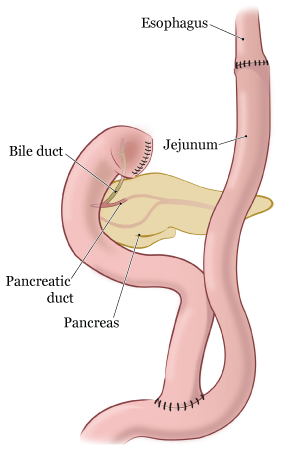
Figure 3. Your digestive system after your subtotal gastrectomy
A total gastrectomy involves removing the entire stomach, nearby lymph nodes, and parts of your esophagus and small intestine. Your esophagus is reconnected to your small intestine so that you can continue to eat and swallow (see Figures 4 and 5).
Figure 4. Your digestive system before your total gastrectomy
Figure 5. Your digestive system after your total gastrectomy
A gastrectomy can be done in different ways. Your surgeon will talk to you about which options are right for you. Depending on what surgery you have, your surgeon will make one or more incisions (surgical cuts) on your belly.
When one long incision is made, it is called an open surgery. Some or all of the stomach is removed through this incision.
When several small incisions are made on the belly, this is called laparoscopic minimally invasive surgery. Small surgical instruments and a laparoscope (a tube-like instrument with a camera) are inserted into the incisions to remove the part of the stomach containing the cancer.
Your surgeon may use a robotic device to help with your surgery.
Before Your Surgery
The information in this section will help you prepare for your surgery. Read through this section when your surgery is scheduled and refer to it as your surgery date gets closer. It contains important information about what you need to do before your surgery. Write down any questions you have and be sure to ask your doctor or nurse.
Preparing for Your Surgery
You and your healthcare team will work together to prepare for your surgery.
Help us keep you safe during your surgery by telling us if any of the following statements apply to you, even if you aren’t sure.
I take a blood thinner. Some examples are heparin, warfarin (Coumadin®), clopidogrel (Plavix®), enoxaparin (Lovenox®), and tinzaparin (Innohep®). There are others, so be sure your doctor knows all the medications you’re taking.
I take prescription medications.
I take any over-the-counter medications, herbs, vitamins, minerals, or natural or home remedies.
I have a pacemaker, automatic implantable cardioverter-defibrillator (AICD), or other heart device.
I have sleep apnea.
I have had a problem with anesthesia in the past.
I have allergies, including to latex.
I am not willing to receive a blood transfusion.
I drink alcohol.
I smoke.
I use recreational drugs.
About Drinking Alcohol
The amount of alcohol you drink can affect you during and after your surgery. It is important that you talk with your healthcare providers about your alcohol intake so that we can plan your care.
Stopping alcohol suddenly can cause seizures, delirium, and death. If we know you are at risk for these complications, we can prescribe medications to help prevent them.
If you drink alcohol regularly, you may be at risk for other complications during and after your surgery. These include bleeding, infections, heart problems, greater dependence on nursing care, and longer hospital stay.
Here are things you can do to prevent problems before your surgery:
Be honest with your healthcare provider about how much alcohol you drink.
Try to stop drinking alcohol once your surgery is planned. If you develop a headache, nausea, increased anxiety, or cannot sleep after you stop drinking, tell your doctor right away. These are early signs of alcohol withdrawal and can be treated.
Tell your healthcare provider if you cannot stop drinking.
Ask us any questions you have about drinking and surgery. As always, all of your treatment information will be kept confidential.
About Smoking
People who smoke can have breathing problems when they have surgery. Stopping even for a few days before surgery can help. If you smoke, your nurse will refer you to our Tobacco Treatment Program. You can also reach the program at 212-610-0507.
About Sleep Apnea
Sleep apnea is a common breathing disorder that causes a person to stop breathing for short periods while sleeping. The most common type is obstructive sleep apnea (OSA). This means that the airway becomes completely blocked during sleep, so no air can get through. OSA can cause serious problems when you have surgery. Please tell us if you have sleep apnea or if you think you might have it. If you use a breathing machine (such as a CPAP) for sleep apnea, bring it with you the day of your surgery.
Within 30 Days of Your Surgery
Presurgical Testing
Before your surgery, you will have an appointment for presurgical testing (PST). The date, time, and location of your PST appointment will be printed on the appointment reminder from your surgeon’s office.
You can eat and take your usual medications the day of your PST appointment. During your appointment, you will meet with a nurse practitioner who works closely with anesthesiology staff (doctors and specialized nurses who will be giving you medication to put you to sleep during your surgery). The nurse practitioner will review your medical and surgical history with you. You will have tests, including an electrocardiogram (EKG) to check your heart rhythm, a chest x-ray, blood tests, and any other tests necessary to plan your care. Your nurse practitioner may also recommend you see other healthcare providers.
Your nurse practitioner will talk with you about which medications you should take the morning of your surgery.
It is very helpful if you bring the following with you to your PST appointment:
A list of all the medications you are taking, including patches and creams.
Results of any tests done outside of MSK, such as a cardiac stress test, echocardiogram (echo), or carotid doppler study.
The name(s) and telephone number(s) of your doctor(s).
Complete a Health Care Proxy Form
If you haven’t already completed a Health Care Proxy form, we recommend you complete one now. A health care proxy is a legal document that identifies the person who will speak for you if you are unable to communicate for yourself. The person you identify is called your health care agent. If you are interested in completing a Health Care Proxy form, talk with your nurse. If you have completed a Health Care Proxy form or if you have any other advanced directive, bring it with you to your next appointment.
Do Breathing and Coughing Exercises
Practice taking deep breaths and coughing before your surgery. You will be given an incentive spirometer to help expand your lungs. For more information, please read How to Use Your Incentive Spirometer. If you have any questions, ask your nurse or respiratory therapist.
Exercise
Try to do aerobic exercise every day, such as walking at least 1 mile, swimming, or biking. If it is cold outside, use stairs in your home or go to a mall or shopping market. Walking will help your body get into its best condition for your surgery and make your recovery faster and easier.
Eat a Healthy Diet
You should eat a well-balanced, healthy diet before your surgery. If you need help with your diet talk to your doctor or nurse about meeting with a dietitian.
Stop taking herbal remedies or supplements 7 days before your surgery. If you take a multivitamin, talk with your doctor or nurse about whether you should continue. For more information, read Herbal Remedies and Cancer Treatment.
You will need to follow a clear liquid diet the day before your surgery. Examples of clear liquids are listed in the table below. Your doctor or nurse will tell you if you will need and extra day of clear liquids or any additional bowel preparation. While you are on this diet:
Do not eat any solid foods.
Make sure to drink plenty of liquids other than water, coffee, and tea. Try to drink at least 1 (8-ounce) glass of clear liquid every hour while you’re awake.
Drink
Do Not Drink
Soups
Clear broth, bouillon, or consommé
Any products with any particles of dried food or seasoning
Sweets
Gelatin, such as Jell-O®
Flavored ices
Sweeteners, such as sugar or honey
All others
Beverages
Clear fruit juices, such as apple, cranberry, lemonade, or grape
Soda, such as ginger ale, 7-Up®, Sprite®, seltzer
Gatorade®
Black coffee (no milk or cream)
Tea (no milk or cream)
Juices with pulp
Nectars
Milk or cream
Alcoholic beverages
Note the Time of Your Surgery
Sleep
Go to bed early and get a full night’s sleep.
Instructions for eating and drinking before your surgery
Do not eat anything after midnight the night before your surgery. This includes hard candy and gum.
Between midnight and up until 2 hours before your scheduled arrival time, you may drink a total of 12 ounces of water (see figure).
Starting 2 hours before your scheduled arrival time, do not eat or drink anything. This includes water.
The Morning of Your Surgery
Take Your Medications as Instructed
If your doctor or nurse practitioner instructed you to take certain medications the morning of your surgery, take only those medications with a sip of water. Depending on what medications you take and the surgery you’re having, this may be all, some, or none of your usual morning medications.
Things to Remember
Do not put on any lotions, creams, deodorants, makeup, powders, or perfumes.
Do not wear any metal objects. Remove all jewelry, including body piercings. The equipment used during your surgery can cause burns if it touches metal.
Leave valuables, such as credit cards, jewelry, or your checkbook at home.
Before you are taken into the operating room, you will need to remove your eyeglasses, hearing aids, dentures, prosthetic device(s), wig, and religious articles, such as a rosary.
If you wear contact lenses, wear your glasses instead.
What to Bring
Sneakers that lace up. You may have some swelling in your feet. Lace-up sneakers can accommodate this swelling.
Only the money you may need for a newspaper, bus, taxi, or parking.
Your portable music player, if you choose. However, someone will need to hold this item for you when you go into surgery.
Your incentive spirometer, if you have one.
Your breathing machine for sleep apnea (such as your CPAP), if you have one.
If you have a case for your personal items, such as eyeglasses, hearing aid(s), dentures, prosthetic device(s), wig, and religious articles such as a rosary, bring it with you.
Your Health Care Proxy form, if you have completed one.
This guide. Your healthcare team will use this guide to teach you how to care for yourself after your surgery.
After Your Surgery
The information in this section will tell you what to expect after your surgery, both during your hospital stay and after you leave the hospital. You will learn how to safely recover from your surgery. Write down any questions you have and be sure to ask your doctor or nurse.
What to Expect
When you wake up after your surgery, you will be taken to the Post Anesthesia Recovery Unit (PACU). You will stay there until you are awake and your pain is under control. Most people go to their room after a few hours in the PACU, but some will need to stay in the PACU overnight for observation.
You will receive oxygen through a thin tube called a nasal cannula that rests below your nose. A nurse will be monitoring your body temperature, pulse, blood pressure, and oxygen levels.
Your visitors can see you briefly in the PACU, usually within 90 minutes after you arrive there. A member of the nursing staff will explain the guidelines to them. After your stay in the PACU, you will be taken to your hospital room in the inpatient unit. There, your nurse will tell you how to recover from your surgery. Below are examples of ways you can help yourself recover safely.
Walk around after surgery. Walking every 2 hours is a good goal. This will help prevent blood clots in your legs.
Use your incentive spirometer. This will help your lungs expand, which prevents pneumonia. For more information, please read our How to Use Your Incentive Spirometerresource.
Commonly Asked Questions: During Your Hospital Stay
Will I have pain after my surgery?
Your doctor and nurse will ask you about your pain often and give you medication to control your pain. Pain medication will be delivered by patient-controlled analgesia (PCA). PCA helps you control your pain by administering your pain medication into a vein (intravenous or IV) or epidural space (in your spine). Read the resource Patient-controlled Analgesia for more information.
If your pain is not relieved, tell your doctor or nurse. You will be given a prescription for pain medication before you leave the hospital. Pain medication may cause constipation (having fewer bowel movements than what is normal for you).
How can I prevent constipation?
Go to the bathroom at the same time every day. Your body will get used to going at that time.
If you feel the urge to go, do not put it off. Try to use the bathroom 5 to 15 minutes after meals.
After breakfast is a good time to move your bowels because the reflexes in your colon are strongest then.
Exercise if you can; walking is an excellent form of exercise.
Slowly increase the fiber in your diet to 25 to 35 grams per day. Fruits, vegetables, whole grains, and cereals contain fiber. If you have an ostomy or have had recent bowel surgery, check with your doctor or nurse before making any changes in your diet.
Both over-the-counter and prescription medications are available to treat constipation. Start with 1 of the following over-the-counter medications first:
Docusate sodium (Colace®) 100 mg. Take _____ capsules _____ times a day. This is a stool softener that causes few side effects. Do not take it with mineral oil.
Polyethylene glycol (MiraLAX®) 17 grams daily.
Senna (Senokot®) 2 tablets at bedtime. This is a stimulant laxative, which can cause cramping.
If you haven’t had a bowel movement in 2 days, call your doctor or nurse.
Will I be able to eat?
You will not be allowed to eat for the first day or 2 following the surgery. Then you will be on a clear liquid diet. After that, your diet will progress to a regular diet as tolerated. You will be able to eat smaller amounts of food than prior to your surgery. You will be encouraged to eat smaller meals, more frequently throughout the day.
Eating a balanced diet high in protein will help you heal after surgery. Your diet should include a healthy protein source at each meal, as well as fruits, vegetables, and whole grains. For more tips on increasing the amount of calories and protein in your diet, ask your nurse for the resource Eating Well During and After Your Cancer Treatment. For more information, please read Eating After Your Gastrectomy or Esophagogastrectomy. If you have questions about your diet, ask to see a dietitian.
How long will I be in the hospital?
Most people are in the hospital for approximately 5 days after having a gastrectomy but this will depend on the exact surgery that is done.
Commonly Asked Questions: After You Leave the Hospital
Will I have pain when I am home?
The length of time each person has pain or discomfort varies. You may still have some pain when you go home and will probably be taking pain medication. Follow the guidelines below.
Take your medications as directed and as needed.
Call your doctor if the medication prescribed for you doesn’t relieve your pain.
Do not drive or drink alcohol while you are taking prescription pain medication.
As your incision heals, you will have less pain and need less pain medication. A mild pain reliever such as acetaminophen (Tylenol®) or ibuprofen (Advil®) will relieve aches and discomfort. However, large quantities of acetaminophen may be harmful to your liver. Do not take more acetaminophen than the amount directed on the bottle or as instructed by your doctor or nurse.
Pain medication should help you as you resume your normal activities. Take enough medication to do your exercises comfortably. Pain medication is most effective 30 to 45 minutes after taking it.
Keep track of when you take your pain medication. Taking it when your pain first begins is more effective than waiting for the pain to get worse.
Can I shower?
Yes. Taking a warm shower is relaxing and can help decrease muscle aches. Use soap when you shower and gently wash your incision. Pat the areas dry with a towel after showering, and leave your incision uncovered (unless there is drainage). Call your doctor if you see any redness or drainage from your incision.
Do not take tub baths until you discuss it with your doctor at the first appointment after your surgery.
How do I care for my incision?
The location of your incision will depend on the type of surgery you had. It is normal to have numbness of the skin below the incision because some of the nerves were cut; this sensation will lessen over time.
By the time you are ready to leave the hospital, your surgical incision will have begun to heal.
You and your caregiver should look at your incision with your nurse before you leave the hospital so you know what it looks like.
If any liquid is draining from your incision, you should write down the amount and color. Call your doctor’s office and speak with the nurse about any drainage from your incision.
Change your bandages at least once a day and more often if they become wet with drainage. When there is no longer any drainage coming from your incision, they can be left uncovered.
If you go home with Steri-StripsTM on your incision, they will loosen and fall off by themselves. If they haven’t fallen off within 10 days, you may remove them.
If you go home with glue over your sutures (stitches), it will also loosen and peel off, similarly to the Steri-Strips.
If your surgeon uses staples to close your incision, you will have them removed at your postoperative visit at the outpatient clinic.
When is it safe for me to drive?
You may resume driving 3 weeks after surgery as long as you are not taking pain medication that may make you drowsy.
What exercises can I do?
Exercise will help you gain strength and feel better. Walking and stair climbing are excellent forms of exercise. Gradually increase the distance you walk. Climb stairs slowly, resting or stopping as needed. Ask your doctor or nurse before starting more strenuous exercises.
When can I lift heavy objects?
Check with your doctor before you do any heavy lifting. Normally, you should not lift anything heavier than 5 pounds for at least 6 weeks. Ask your doctor how long you should avoid heavy lifting.
When is my first appointment after my surgery?
Your first appointment after surgery will be in 1 to 3 weeks after you leave the hospital. Your nurse will give you instructions on how to make this appointment, including the phone number to call.
How can I cope with my feelings?
After surgery for a serious illness, you may have new and upsetting feelings. Many people say they felt weepy, sad, worried, nervous, irritable, and angry at one time or another. You may find that you cannot control some of these feelings. If this happens, it’s a good idea to seek emotional support.
The first step in coping is to talk about how you feel. Family and friends can help. Your nurse, doctor, and social worker can reassure, support, and guide you. It is always a good idea to let these professionals know how you, your family, and your friends are feeling emotionally. Many resources are available to patients and their families. Whether you are in the hospital or at home, the nurses, doctors, and social workers are here to help you and your family and friends handle the emotional aspects of your illness."
According to the Cleveland Clinic, you can develop Post Gastrectomy Syndrome. The information about Post Gastrectomy Syndrome is the following,
"Post-Gastrectomy Syndrome
The primary function of the stomach is to act as a reservoir, initiate the digestive process, and release its contents gradually into the duodenum so that digestion in the small bowel is optimally performed.
Causes
Patients with a diagnosis of gastric cancer, trauma, or complicated peptic ulcer disease may require a gastrectomy, which is the surgical removal of a portion of or, on occasion, all of the stomach. The anatomical changes that result after gastrectomy affect the emptying time of the stomach. If the pyloric valve located between the stomach and first part of the small intestine (duodenum) is removed, the stomach is unable to retain food long enough for partial digestion to occur. Food then travels too rapidly into the small intestine producing a condition known as the post-gastrectomy syndrome.
Symptoms
This syndrome is characterized by a lowered tolerance for large meals, rapid emptying of food into the small intestine or 'dumping,' abdominal cramping pain, diarrhea, lightheadedness after eating as well as increased heart rate and sharp drops in blood sugar levels. In the 'early' dumping syndrome, symptoms occur approximately one-half hour after eating whereas in the 'late' dumping syndrome they appear two to four hours after eating. The carbohydrate component draws water into the intestinal lumen causing sudden fluid shifts in the early dumping whereas late dumping is caused by a reactive hypoglycemia. An estimated 25-50% of all patients who have undergone gastric surgery have some symptoms of gastric dumping. The incidence and severity of symptoms are related directly to the extent of gastric surgery.
Complications
Complications of post-gastrectomy syndrome include anemia as a result of vitamin B12 or iron malabsorption and osteoporosis. These problems generally occur months or even years after gastric surgery. Vitamin B12 malabsorption occurs when a protein known as intrinsic factor is either not produced by the stomach (this is a condition called pernicious anemia) or when the proximal stomach is resected (the portion of the stomach that produces intrinsic factor). In either case, that absence of intrinsic factor leads to the poor absorption of vitamin B12. Under normal circumstances intrinsic factor binds to vitamin B12 and assists with the absorption of this vitamin in the lower portion of the small bowel. When vitamin B12 is poorly absorbed, anemia and, in some cases, poor nerve function can occur. This generally does not happen for several years because vitamin B12 is stored in large amounts in the liver.
Iron deficiency anemia develops because removal of the stomach often leads to a marked decrease in the production of gastric acid. This acid is necessary to convert dietary iron to a form that is more readily absorbed in the duodenum. Anemia usually does not occur for a few years after gastric surgery because iron is stored in moderately large amounts in the bone marrow, where red blood cells are produced.
Osteoporosis develops as a result of poor calcium absorption, another problem that occurs after gastric surgery. Under normal circumstances, calcium absorption, which occurs in the duodenum and proximal small bowel, is modest at best, with large amounts being lost in the bowel movement. Following gastric surgery, calcium absorption is even less efficient as a result of rapid emptying of the stomach. Calcium also binds tightly to unabsorbed dietary fat which further interferes with its absorption. Symptoms of osteoporosis may develop ten or more years after gastric surgery because of the large amount of calcium that is normally stored in bone.
Treatment
Treatment of post-gastrectomy syndrome includes initiation of a post-gastrectomy diet, which is high in protein, low in carbohydrates, and low in concentrated sweets. This diet should be consumed as five or six small meals, with limited fluid intake during meals. On occasion, medications may be required to help control these symptoms. Vitamin B12 deficiency can be prevented by providing vitamin B12 shots once each month indefinitely. Oral iron and calcium supplements are often needed to prevent the development of deficiencies in these minerals."
If you have a personal story that you would like to share based on your experience with this surgery, please feel free to email it to me at: emilysstomach[at]gmail.com.
"Unless you're a genetic anomaly, it's likely you will meet people you don't like throughout your lifetime. Whether it's your mother-in-law or one of your colleagues, you're bound to come across someone you simply don't click with.
According to Deep Patel, author of the book A Paperboy's Fable: The 11 Principles of Success, it helps to remember nobody's perfect. That includes you.
In a blog post for Entrepreneur.com, Patel highlights some tips successful people use to deal with people they don't get along with. After all, it's unlikely you'll simply be able to avoid people you don't like — in fact, Patel argues if you restrict who you can work with, you are only limiting yourself.
Instead of burying your head in the sand, try and shift your perspective in the ways successful people do. Here are some tips from Patel and other sources such as Psychology Today.
1. Accept that you can't get on with everyone
As much as we hope to like everyone we meet, it often simply isn't the case. Patel says the first step to dealing with the people you don't click with is accepting nobody gets on with everyone, and that's okay. It doesn't mean you're a bad person, and it doesn't mean they are either (not necessarily, anyway.)
According to psychologist Dr Susan Krauss in a blog post on Psychology Today, it's likely that you and the person just aren't a good fit. Consultant and author Beverly D. Flaxington explains in another blog post on Psychology Today that our behavioural styles can get come between people. Some are dominant, whereas others are timid. Some people are optimists and others consider themselves 'realists.'
A research paper by Hamstra et al looked at something called 'regulatory fit,' which translates as: we are much more likely to put effort into the things we like doing. Chances are you don't enjoy interacting with the people you don't like, and so you don't put much effort in. Over time, this lack of effort can turn into contempt.
2. Try and put a positive spin on what they are saying
Krauss says you could try and look at how people are acting differently. Your in-laws might not have meant to imply that you aren't smart, and your co-worker may not actually be trying to sabotage you.
Even if the person you're having difficulty with is aggravating you on purpose, getting angry about it will probably just make you look bad. So try and give them the benefit of the doubt.
3. Be aware of your own emotions
Patel says it's important to remember your own emotions matter, but ultimately you alone have control over how you react to situations. People will only drive you crazy if you allow them to. So don't let your anger spin out of control.
If someone is rubbing you the wrong way, recognise those feelings and then let them go without engaging with the person. Sometimes just smiling and nodding will do the trick.
The key, Patel says, is in treating everyone you meet with the same level of respect. That doesn't mean you have to agree with a person you don't like or go along with what they say, but you should act civilised and be polite. In doing this, you can remain firm on your issues but not come across like you're attacking someone personally, which should give you the upper hand.
4. Don't take it personally and get some space
More often than not a disagreement is probably a misunderstanding. If not, and you really do fundamentally disagree with someone, then try and see it from their perspective.
Try not to overreact, because they may overreact in return, meaning things escalate quickly and fiercely. Try to rise above it all by focusing on facts, and try to ignore how the other person is reacting, no matter how ridiculous or irrational. Concentrate on the issue, Patel says, not the person.
If you need some space, take it. You're perfectly within your rights to establish boundaries and decide when you interact with someone. If you feel yourself getting worked up, take a time-out and get some breathing space. President of TalentSmart Dr. Travis Bradberry explains it simply in a post on LinkedIn: if they were smoking, would you sit there all afternoon inhaling the second-hand smoke? No, you'd move away and get some fresh air.
5. Express your feelings calmly and consider using a referee
Usually, the way we communicate is more important than what we actually say. If someone is repeatedly annoying you and it's leading to bigger problems, Patel says it's probably time to say something.
However, confrontation doesn't have to be aggressive. Patel recommends you use 'I' statements, such as 'I feel annoyed when you do this, so could you please do this instead.'
Being as specific as possible will make it more likely the person will take what you're saying on board. It will also give them a better opportunity to share their side of the story.
Krauss says it might be a good idea to use another person as a mediator in these discussions because they can bring a level of objectivity to a situation. You may not end up as friends, but you might find out a way to communicate and work together in an effective way. She says learning to work with people you find difficult is a very fulfilling experience, and it could become one more way of showing how well you overcome barriers.
6. Pick your battles
Sometimes it might just be easier to let things go. Not everything is worth your time and attention. You have to ask yourself whether you really want to engage with the person, or your effort might be better spent just getting on with your work, or whatever else you're doing.
Patel says the best way to figure this out is weighing up whether the issue is situational. Will it go away in time, or could it get worse? If it's the latter, it might be better expending energy into sorting it out sooner or later. If it's just a matter of circumstance, you'll probably get over it fairly quickly.
7. Don't be defensive
If you find someone is constantly belittling you or focusing on your flaws, don't bite. The worst thing you can do is be defensive. Patel says this will only give them more power. Instead, turn the spotlight on them and start asking them probing questions, such as what in particular their problem is with what you're doing.
If they start bullying you, call them out on it. If they want you to treat them with respect, they have to earn it by being civil to you, too. Dr Berit Brogaard, a neuroscientist, explains in a blog post on Psychology Today that workplace gossip and bullying can be a method of power play, or a way of bullying others into submission.
If you want to be sneaky to get someone to agree with you, there are psychological tricks you can use. Research suggests you should speak faster when disagreeing with someone so they have less time to process what you're saying. If you think they might be agreeing with you, then slow down so they have time to take in your message.
8. Ultimately, remember you are in control of your own happiness
If someone is really getting on your nerves, it can be difficult to see the bigger picture. However, you should never let someone else limit your happiness or success.
If you're finding their comments are really getting to you, ask yourself why that is. Are you self-conscious about something, or are you anxious about something at work? If so, focus on this instead of listening to other people's complaints.
You alone have control over your feelings, so stop comparing yourself to anyone else. Instead, remind yourself of all your achievements, and don't let someone gain power over you just because they momentarily darken your day."
"How Not to Care When People Don't Like You
Rebecca Fishbein
3/29/18 9:00am
When I was in high school, I found out that my friends didn’t like me. One of the girls in my 'group' told me I wasn’t invited to a birthday party because 'everyone' thought I was annoying—which, to be honest, at 15 I probably was—and for months I was ostracized. It took some time for me to worm my way back into the gang, but until then, I was devastated, and I swore I would spend the rest of my life being likable.
But, as David Foster Wallace (sorry) wrote in Infinite Jest (sorry again), 'certain persons simply will not like you not matter what you do,' and no matter how likable you think you are, you’re not going to win over every person you meet. 'Remember that it is impossible to please everyone,' Chloe Brotheridge, a hypnotherapist and anxiety expert, tells us. 'You have your own unique personality which means some people will love and adore you, while others may not.' Of course, while this concept is easy to understand on its face, it’s difficult to keep your perspective in check when you find you’re, say, left out of invitations to happy hours with co-workers, or getting noncommittal responses from potential new friends, or you overhear your roommates bad-mouthing you. Rejection is painful in any form, whether it be social or romantic, and it’s a big ego blow to get bumped from the inner circle.
Before you freak out, keep in mind that it’s not just normal to be occasionally disliked, but in fact, it’s healthy. Rejection is a way to suss out who’s compatible with whom, and just as getting romantically dumped by someone leaves you open to finding a better suited partner, getting axed from a social group gives you space to find folks that are a little more your speed. Plus, it’s empowering not to fear being disliked—not that you should run around violating social norms, but when you’re not wasting energy molding your personality to someone else’s to be accepted, you’re more likely to find people who genuinely like you for you, and those relationships are far less exhausting to keep up.
Still, it sucks to feel disliked. Here’s how to get through it without falling down a rabbit hole of sadness.
Everyone Is Not Constantly Being Friends Without You
Everyone does not have more friends than you, even though, as a study at UBC Vancouver indicated, It’s okay to feel the pain [sic].
Humans are social creatures, and so we experience painful biological responses to rejection. 'Historically it was essential for our survival,' Brotheridge explains. 'When we were evolving and living in tribes, being rejected and kicked out of the community would have been a matter of life or death.' When we get rejected, our brains register an emotional chemical response so strong, it can physically hurt. We’re also likely to cycle through a series of responses that’s not dissimilar to the stages of grief.
First, the blame game starts. 'The first stop on the train is self blame: ‘It’s my fault, I did something to upset them,’' Sean Grover, a psychotherapist and author of When Kids Call the Shots, tells us.
Up next is shame: 'You feel ashamed, you feel humiliated, you feel weak,' Grover says.
Then, like any dumped individual, you’ll probably try to win back your rejecter. 'Not because, necessarily, you want them to like you, but you just don’t like this feeling of being disliked,' Grover says. 'It’s, ‘Let me get you to like me so I can feel better about myself.’' Last but not least, you’ll likely feel like you’re a failure, and that’s when it gets dark. 'These are very, very, primitive early feelings. For somebody not to like you, it induces a regression,' Grover says. 'Generally, that brings you back to high school, middle school, elementary school, when it was all about whether you’re cool or not. Once you get caught in the feeling, it really pulls you under, and then you’re struggling.'
These feelings aren’t exactly pleasant, but they’re also perfectly healthy and normal, so long as you don’t end up dwelling on them, preventing yourself from moving forward.
Even if Twitter finally bans the Nazis (lol yeah right), there will always be boring, dumb, Know [sic] that it’s not (totally) your fault.
This type of rejection is literally personal, and it’s easy to start questioning your self worth when someone makes it clear they don’t like you. But we all act out of our own insecurities and unique experiences, and for the most part, being disliked is a measure of mutual compatibility. So, it’s not really that it’s not you but them, so much as it’s both you and them. 'This person, this situation, where they are in their life, it’s not compatible to where you are,' Jennifer Verdolin, an animal behavior expert and adjunct professor at Duke University, tells us. 'We have preferences in terms of personality, and that’s not to say that your personality is bad. It’s different from mine, and I prefer to hang around people who are similar to me.'
Sometimes, the people who dislike you don’t think certain facets of your personality jibe with theirs; sometimes, you just don’t offer them enough social capital to be worth their time. 'Because we’re a very social species with a pretty intense dominance hierarchy, especially when it comes to work, and sometimes in social situations, people make specific strategic alliances and switch alliances as it suits them to meet their needs as they define them,' Verdolin says. 'So people will try to achieve status, and a lot of time, whether they like you or don’t like you may have nothing to do with who you are.'
Either way, likability has a lot to do with what you bring to someone else’s table, whether or not you realize it. 'We see this in all kinds of species. They preferentially tend to spend time, outside of mating, with either individuals who are similar to them in status, individuals who are similar to them in personality, individuals who are similar to them in some sort of way genetically, so, family,' Verdolin says. 'So if you don’t have anything in common that is equally valuable to both parties, then you will likely be rejected. It’s kind of an inevitability.'
Why It Feels So Good to Cancel Plans Last Minute, and How to Stop
There’s something magical about cancelling plans last minute—yes, I’ve heard the John Mulaney joke. [sic] But watch for signs of your own bad behavior.
While you shouldn’t always blame yourself if someone doesn’t like you, if you’re finding this is a pattern, you may want to take an unbiased look at your own behavior. 'When I put people in a [therapy] group, I get to see immediately what problems or tics or bad social habits they have,' Grover says. He recalls a successful, handsome male patient of his who was having trouble holding onto romantic relationships. Though they were unable to solve the problem together in individual therapy, Grover managed to convince the patient to join a group. 'Within five minutes, I was horrified,' Grover says. 'He gets very anxious in front of people, and to camouflage his anxiety he becomes overly confident, which comes across as arrogant. The women in the group commented that he was becoming less popular the more they got to know him.'
Make Friends As an Adult By Reconnecting With Acquaintances
Making new friends as an adult is hard. However, you might have more options than you think.
The patient’s anxiety was manifesting in such a way that he had difficulty relating to people in a social setting, but because our own egos tend to protect us from our faults, he wasn’t aware of his bad habits. 'I had to help him be aware of how his anxiety manifested,' Grover said. 'Anxiety can make people act aggressive or really anxious, and in a group situation it’s super effective to see that.'
Image Source: On Image
How I Work: NYC's Only Taffy Maker
9/10/18 11:30am
One way to find out what’s going on, Verdolin says, is to ask for feedback as to why you’re disliked. Then, if someone tells you, say, you’re annoying, or overly braggy, or self-obsessed, you can take a step back and analyze whether there’s some validity to the criticism. 'Ultimately you have to know who you are well enough to say, okay, that information sounds pretty valid, I do tend to do that, I can see why that might not be attractive to other people, so I’m going to work on changing it,' Verdolin says. 'You might be being given important information that you should take a look at seriously, and evaluate to see if there’s truth to it.'
Still, remember that while some of your behaviors might turn people off, likability is typically a two-way street. 'It is, more often than not, some sort of reflection of [the other person’s] history, their prejudices, their fears,' Grover says.
The Best Way to Answer 'Do I Look Okay?'
You’re getting ready for a big night on the town when your companion turns to you and asks, “Do I…Remind yourself that making new friends is no easy task [sic].
One of my greatest fears is that I’ll start a new job or move to a new place where I don’t know anyone and have to make new friends. Changing your social circle can be isolating; it’s when you’re most likely to feel disliked or suffer from social anxiety. 'I think we have a little bit of an unrealistic expectation that we should be able to [enter social groups] anywhere, with all people,' Verdolin says. 'When you’re first trying to establish rapport in relationships with people in, say, a new work environment, you’re coming into a dynamic that’s already set in structure. There are already cliques, there are already personalities, there are already dynamics, and you have no idea what you’re stepping into.'
Verdolin suggests that people faced with starting a new job or making a big move start slowly to get a sense of their new social environment. 'With animals, sometimes they’ll integrate by having a sampling interaction with everyone else in the group before making decisions, to kind of get a lay of the land, so to speak, before trying to jump right in,' Verdolin says. At a new job, for instance, it might be worth suggesting going to lunch with folks one-on-one, to find the group’s friendliest entry point. 'Some people are very welcoming and some people are not,' Verdolin says. Get to know people slowly, and focus your energy on those who seem most receptive, rather than the group’s most exclusive members, or toughest nuts to crack.
This Is How Many Friends You Need to Be Happy
Friends make you happy, healthy, and they’ll be there for you when the rain starts to pour. But how:
Spend extra time with the people who do like you
Even if you find yourself on the outs with some folks, chances are, you’ve at least got a few people you can rely on when you’re feeling low. 'Spending time with people that care about you can boost your self-esteem and help you to feel more secure,' Brotheridge says. Besides acting as a balm to your wounded ego, focusing your energies on relationships with people who appreciate you will, in the larger picture, be a much more fulfilling use of your time and social energy.
And keep in mind that the best way to make genuine friendships is to be genuine yourself. 'If you just walk around wanting to be liked, it’s very stressful, and people will read that as inauthentic,' Grover says.
And tell the haters to suck it.
At least, tell them in your head. Grover says that when all else fails, it’s best to embrace having the occasional enemy. “Delight in it. Really, just enjoy it,' he says. After all, as Grover says, sometimes it’s actually better to be formidable. 'If people are jealous or whatever, all feelings are welcome.' You don’t need to go around antagonizing people, but if someone doesn’t like you and the feeling is mutual, you don’t necessarily have to go out of your way to appease them, either.'"
As a patient, you do have rights and responsibilities when it comes to the doctor's office or the hospital. I have written about this previously, but I wanted to dedicate an article to it so that you would be aware of your rights the next time you are in a medical professional setting.
The health and well-being of patients depends on a collaborative effort between patient and physician in a mutually respectful alliance. Patients contribute to this alliance when they fulfill responsibilities they have, to seek care and to be candid with their physicians, for example.
Physicians can best contribute to a mutually respectful alliance with patients by serving as their patients’ advocates and by respecting patients’ rights. These include the right:
(a) To courtesy, respect, dignity, and timely, responsive attention to his or her needs.
(b) To receive information from their physicians and to have opportunity to discuss the benefits, risks, and costs of appropriate treatment alternatives, including the risks, benefits and costs of forgoing treatment. Patients should be able to expect that their physicians will provide guidance about what they consider the optimal course of action for the patient based on the physician’s objective professional judgment.
(c) To ask questions about their health status or recommended treatment when they do not fully understand what has been described and to have their questions answered.
(d) To make decisions about the care the physician recommends and to have those decisions respected. A patient who has decision-making capacity may accept or refuse any recommended medical intervention.
(e) To have the physician and other staff respect the patient’s privacy and confidentiality.
(f) To obtain copies or summaries of their medical records.
(g) To obtain a second opinion.
(h) To be advised of any conflicts of interest their physician may have in respect to their care.
(i) To continuity of care. Patients should be able to expect that their physician will cooperate in coordinating medically indicated care with other health care professionals, and that the physician will not discontinue treating them when further treatment is medically indicated without giving them sufficient notice and reasonable assistance in making alternative arrangements for care."
IN ADDITION TO PATIENT RIGHTS, A PATIENT ALSO HAS CERTAIN RESPONSIBILITIES. THESE RESPONSIBILITIES ARE PRESENTED TO THE PATIENT IN THE SPIRIT OF MUTUAL TRUST AND RESPECT.
The patient has the responsibility to provide accurate and complete information concerning his/her present complaints, past illnesses, hospitalizations, medications (including over the counter products and dietary supplements), allergies and sensitivities, and other matters relating to his/her health.
The patient and family are responsible for asking questions when they do not understand what they have been told about the patient’s care or what they are expected to do.
The patient is responsible for following the treatment plan established by his/her physician, including the instructions of nurses and other health professionals as they carry out the physician’s orders.
The patient is responsible for keeping appointments and for notifying the facility or physician when he/she is unable to do so.
The patient/family member/patient representative is responsible for disposition of the patient valuables.
Provide a responsible adult to transport him/her home from the facility and remain with him/her for a period of time designated by his/her physician unless exempted from that requirement by the attending physician.
In the case of pediatric patients, a parent or guardian is to remain in the facility for the duration of the patient’s stay in the facility. The Center does not see patients under the age of 16 years.
The patient is responsible for his/her actions should he/she refuse treatment or not follow his/her physician’s orders.
The patient is responsible for assuring that the financial obligations of his/her care are fulfilled as promptly as possible.
The patient is responsible to inform the facility whether the patient has a living will, medical power of attorney or other directive that could affect his/her care.
The patient is responsible for being respectful of all of the health care providers and staff, as well as other patients."
A time of illness is a stressful time for patients as well as for their families. The best-laid plans can go awry, judgment is impaired, and, put simply, you are not at your best when you are sick. Patients need someone who can look out for their best interests and help navigate the confusing healthcare system–in other words, an advocate.
What is a patient advocate?
An advocate is a “supporter, believer, sponsor, promoter, campaigner, backer, or spokesperson.” It is important to consider all of these aspects when choosing an advocate for yourself or someone in your family. An effective advocate is someone you trust who is willing to act on your behalf as well as someone who can work well with other members of your healthcare team such as your doctors and nurses.
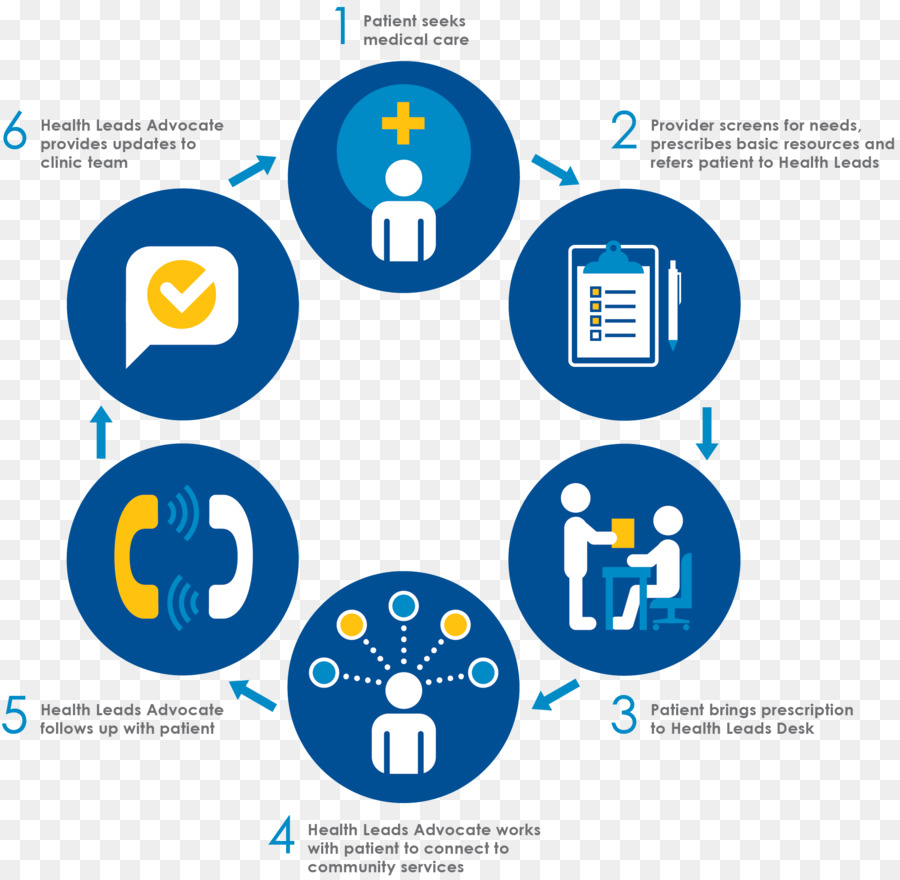
An advocate may be a member of your family, such as a spouse, a child, another family member, or a close friend. Another type of advocate is a professional advocate. Hospitals usually have professionals who play this role called Patient Representatives or Patient Advocates. Social workers, nurses and chaplains may also fill this role. These advocates can often be very helpful in cutting through red tape. It is helpful to find out if your hospital has professional advocates available, and how they may be able to help you.
Using an advocate – getting started
Select a person you can communicate with and that you trust. It’s important to pick someone who is assertive and who has good communication skills. Make sure that the person you select is willing and able to be the type of advocate that you need.
Decide what you want help with and what you want to handle on your own. For example, you may want help with:
Clarifying your options for hospitals, doctors, diagnostic tests and procedures or treatment choices
Getting information or asking specific questions
Writing down information that you receive from your caregivers, as well as any questions that you may have
Assuring that your wishes are carried out when you may not be able to do that by yourself.
Decide if you would like your advocate to accompany you to tests, appointments, treatments and procedures. If so, insist that your doctor and other caregivers allow this.
Be very clear with your advocate about what you would like them to know and be involved in—Treatment decisions? Any change in your condition? Test results? Keeping track of medications?
Let your physician and those caring for you know who your advocate is and how you want them involved in your care
Arrange for your designated advocate to be the spokesperson for the rest of your family and make sure your other family members know this. This will provide a consistent communication link for your caregivers and can help to minimize confusion and misunderstandings within your family.
Make sure your doctor and nurses have your advocate’s phone number and make sure your advocate has the numbers for your providers, hospital and pharmacy, as well as anyone else you may want to contact in the case of an emergency."
"Nancy Davenport-Ennis, Founder of Patient Advocate Foundation became involved in legislative reform on behalf of cancer patients while a dear friend of hers, Cheryl Grimmel, was battling both breast cancer and her insurance company. As Cheryl valiantly fought her fight, Nancy volunteered with the Virginia Task Force for Insurance Reform - sharing the previously underrepresented patient’s perspective and fought to reform insurance coverage for cancer patients. Victory for the task force came with the passage of Virginia House Bill 240 sponsored by Delegate Mary T. Christian in 1994.
Cheryl lost her battle with breast cancer in December 1994, and on the night of her funeral, as the rest of the world was ringing in the New Year, Nancy and Jack Ennis wrote business plans for two complementary nonprofit organizations geared towards solving the issues faced by patients like their friend Cheryl. National Patient Advocate Foundation (NPAF) and Patient Advocate Foundation were born in concept that night and became a reality shortly thereafter.
Cheryl's strength in the face of her battle serves as an inspiration to those at Patient Advocate Foundation as they work and interact with patients in need.
Our case managers advocate and mediate on behalf of patients to provide avenues of access for therapies, therapeutic agents and devices deemed medically efficacious by the medical and scientific communities while working to find sources of reimbursement to pay for care.
n the summer of 2013, after founding and serving as CEO for both PAF and NPAF for more than 17 years, Nancy Davenport-Ennis stepped away from the day-to-day management of both organizations, remaining as Chair Emerita. In July 2013, Alan Balch Ph.D. was named Chief Executive Officer, and is responsible for the operation and leadership of both organizations.
Today, both NPAF and PAF are national leaders on the forefront of important issues within patient-focused healthcare and serve as the voice of patients in need. At the helm are an Executive Board, Scientific Advisory Committee, and Honorary Board - all made possible by support from our Partners in Progress and generous community donors."
On their website they have a lot of resources to help you if you need help with insurance, loans, and that sort of thing,
"Case Management Services & MedCareLines
When PAF originally opened its doors in 1996, it did so offering one-on-one personal advocate services to patients battling serious disease. Today personalized case management remains core to what we do for patients. These services are provided individually to those patients that are facing a chronic, life-threatening or debilitating diagnosis, and the caregivers and providers that are working on behalf of a patient. Just like on that first day, PAF's case management services are provided at no cost to patients in need."
"What’s the Difference Between Hospital Patient Advocates and Independent Advocates?
Posted by: Trisha Torrey
Francine reports:
After my husband Leonard had surgery last week, he stayed in the hospital four more days. I stayed by his side as much as I could and waited every day for the surgeon to check on him. I had a million questions! But I never saw the surgeon again once the surgery was over.
I waited patiently for the first day after the surgery. No surgeon. I called the surgeon’s office and they would not make an appointment for me, or even promise he would return my call, because it was my husband who had the surgery; they told me I would just have to hope to catch him when he visited my husband, which he would do once each day my husband was in the hospital.
I asked the nurses when the surgeon would come by. They told me he stops in every morning around 6 AM. So I got to the hospital by 5:45 – and they told me I had just missed him. I would give the hospital nurses my questions and they would give them to the surgeon, but I never got the answers.
Finally, the nurses suggested I go see the hospital’s patient advocate and tell her I wanted to see the surgeon – so I did. She was very pleasant, and tried to be helpful. She told me she would try to get the surgeon to contact me but that he had a reputation for avoiding patients’ family members. No promises. And still no surgeon.
I am furious! I was never able to get my questions answered, and now my husband has an appointment for follow up – and I don’t know how I’ll keep my mouth shut when we get to the appointment! He has had all kinds of problems since the surgery, and I don’t feel as if he got the care he needed because I wasn’t allowed to ask questions.
Unfortunately, Francine’s story is repeated hundreds (or thousands) of times a day. The details vary from patient to patient, but the part we’re going to focus on here is – how helpful could the hospital’s patient advocate be? And what could Francine have done differently?
In recent years, hospitals have begun stepping up their games to improve the patient’s hospital experience because Medicare’s rules changed, tying patient satisfaction to hospital revenue. I have my own opinions on how they have done that (As in – hospital experience just means a different kind of marketing. “Let’s improve the food, then patients won’t complain as loudly when no one answer the buzzer!) One way to improve the patient’s experience is to be sure there is someone who can listen to complaints. That person would be the hospital’s patient advocate.
Further, the Joint Commission, which is the accreditation body for hospitals, requires a patient advocate be available at all times in a hospital. These patient advocates have different names in different systems: patient advocates, patient representatives, care managers, ombudsmen… They are all tasked with assisting the hospital’s patients and their loved ones.
These patient advocates have become the customer service department with a twist.
Before I explain that twist to you, let me make sure you understand something important: hospital patient advocates do what they can to help their 'customers.' They are a good liaison to the hospital, and to the hospital’s medical and financial personnel. They can often run interference, mediate, or satisfy a complaint about the hospital. Knowing the constraints they are under, I have a lot of respect for these hospital customer service folks.
So What’s the Twist?
But that’s where the twist comes in. That is, that in most cases, the hospital’s patient advocate works for the Risk Management Department of the hospital. Let me repeat that: the patient advocate works for the hospital (meaning, not for you!) and in the vast majority of hospitals in the US, works for the Risk Management Department – which is the legal department. Risk Management is the euphemism for “make sure we don’t get sued.” In other words, the patient advocate is only there to cover the backside of the hospital. If they happen to help a patient or two along the way – well then – that’s nice, too.
What does this mean to you?
When the hospital’s patient advocate couldn’t get the surgeon to answer Francine’s questions, then Francine had only one recourse: an independent, private patient advocate. The hospital advocate’s allegiance meant she could not cross that line – the line that was so necessarily crossed to “encourage” the surgeon to connect with Francine.
The Allegiance Factor is an important concept – the point of today’s post. When an advocate is employed by a hospital, or by an insurance company, and because they have a financial stake in your care, then they cannot and will not be able to provide all the help you need because their allegiance is to their employer. That’s why Francine wasn’t able to get the answers she needed; because the advocate could only push so far without endangering her own job knowing the surgeon would subsequently have taken it up with her bosses in the Risk Management Department.
On the other hand, the independence of a private advocate means she isn’t trying to cover anyone else’s backside except YOURs because she works directly for you – her allegiance is solely focused on you.
If you or a loved one is hospitalized and you don’t seem to be able to get the service you need or your questions answered, then by all means, start with the hospital’s patient advocate.
But if you’re smart, you’ll have already hired an independent advocate to be part of your team. If you need answers or action, then it will be the allegiance of your private advocate who gets them answered."
What Is a Hospital Patient Advocate? (00:01:33)
Video Transcript
Having to stay in the hospital can raise a lot of questions.
Questions about a health problem ... treatments, tests, equipment, medicines, bills, who does what ... the list goes on.
And the hospital staff does its best to answer your questions.
Everyone wants to help out ... whether it's an X-ray technician, a nurse, or your doctor.
But sometimes, you don't get as much information as you'd like ...
... or maybe you don't agree with something.
The hospital knows that these things happen sometimes.
And that's why it has someone ... the hospital patient advocate ...
to help you when you're not getting the answers you need.
The patient advocate helps make your voice heard ...
and works with other staff members to take care of questions and problems.
This can be before, during, or after a hospital stay.
Here are some examples of situations where an advocate could help.
You've been waiting all day for a test result. Now it's early evening.
You've asked several people about your test result, but you haven't received it yet.
Or let's say you want to know what each of your medicines is for, but ... after talking to the nurse several times, it's still not clear to you.
Or maybe you and your family don't understand your doctor's treatment plan, and you can't get the answers you need.
Your hospital staff wants to help. But when there's a problem ...
and you feel frustrated or lost ... it's important to take charge of your health and ask for the hospital patient advocate.
Current as of: December 13, 2018
Author: Healthwise Staff
Medical Review:Catherine Devany Serio, PhD - Psychology, Behavioral Health & Kathleen Romito, MD - Family Medicine & Adam Husney, MD - Family Medicine
This information does not replace the advice of a doctor. Healthwise, Incorporated disclaims any warranty or liability for your use of this information. Your use of this information means that you agree to the Terms of Use and Privacy Policy. Learn How this information was developed.
To learn more about Healthwise, visit Healthwise.org.
PeaceHealth endeavors to provide comprehensive health care information, however some topics in this database describe services and procedures not offered by our providers or within our facilities.
Health Information Library
Terms & Conditions Privacy Rights & Practices PeaceHealth Home For Employees For the Media For Vendors
 Image Source: https://www.nostomachforcancer.org/about/life-without-a-stomach/gastrectomy