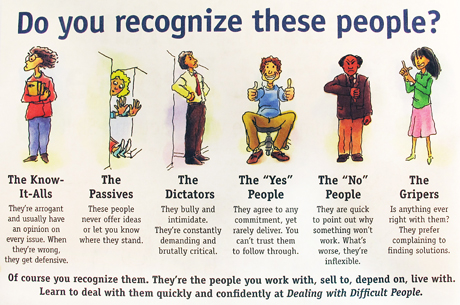
According to https://www.independent.co.uk/life-style/8-ways-to-deal-with-people-that-you-dont-like-a7810126.html,
"Unless you're a genetic anomaly, it's likely you will meet people you don't like throughout your lifetime. Whether it's your mother-in-law or one of your colleagues, you're bound to come across someone you simply don't click with.
According to Deep Patel, author of the book A Paperboy's Fable: The 11 Principles of Success, it helps to remember nobody's perfect. That includes you.
In a blog post for Entrepreneur.com, Patel highlights some tips successful people use to deal with people they don't get along with. After all, it's unlikely you'll simply be able to avoid people you don't like — in fact, Patel argues if you restrict who you can work with, you are only limiting yourself.
Instead of burying your head in the sand, try and shift your perspective in the ways successful people do. Here are some tips from Patel and other sources such as Psychology Today.
1. Accept that you can't get on with everyone
As much as we hope to like everyone we meet, it often simply isn't the case. Patel says the first step to dealing with the people you don't click with is accepting nobody gets on with everyone, and that's okay. It doesn't mean you're a bad person, and it doesn't mean they are either (not necessarily, anyway.)
According to psychologist Dr Susan Krauss in a blog post on Psychology Today, it's likely that you and the person just aren't a good fit. Consultant and author Beverly D. Flaxington explains in another blog post on Psychology Today that our behavioural styles can get come between people. Some are dominant, whereas others are timid. Some people are optimists and others consider themselves 'realists.'
A research paper by Hamstra et al looked at something called 'regulatory fit,' which translates as: we are much more likely to put effort into the things we like doing. Chances are you don't enjoy interacting with the people you don't like, and so you don't put much effort in. Over time, this lack of effort can turn into contempt.
2. Try and put a positive spin on what they are saying
Krauss says you could try and look at how people are acting differently. Your in-laws might not have meant to imply that you aren't smart, and your co-worker may not actually be trying to sabotage you.
Even if the person you're having difficulty with is aggravating you on purpose, getting angry about it will probably just make you look bad. So try and give them the benefit of the doubt.
3. Be aware of your own emotions
Patel says it's important to remember your own emotions matter, but ultimately you alone have control over how you react to situations. People will only drive you crazy if you allow them to. So don't let your anger spin out of control.
If someone is rubbing you the wrong way, recognise those feelings and then let them go without engaging with the person. Sometimes just smiling and nodding will do the trick.
The key, Patel says, is in treating everyone you meet with the same level of respect. That doesn't mean you have to agree with a person you don't like or go along with what they say, but you should act civilised and be polite. In doing this, you can remain firm on your issues but not come across like you're attacking someone personally, which should give you the upper hand.
4. Don't take it personally and get some space
More often than not a disagreement is probably a misunderstanding. If not, and you really do fundamentally disagree with someone, then try and see it from their perspective.
Try not to overreact, because they may overreact in return, meaning things escalate quickly and fiercely. Try to rise above it all by focusing on facts, and try to ignore how the other person is reacting, no matter how ridiculous or irrational. Concentrate on the issue, Patel says, not the person.
If you need some space, take it. You're perfectly within your rights to establish boundaries and decide when you interact with someone. If you feel yourself getting worked up, take a time-out and get some breathing space. President of TalentSmart Dr. Travis Bradberry explains it simply in a post on LinkedIn: if they were smoking, would you sit there all afternoon inhaling the second-hand smoke? No, you'd move away and get some fresh air.
5. Express your feelings calmly and consider using a referee
Usually, the way we communicate is more important than what we actually say. If someone is repeatedly annoying you and it's leading to bigger problems, Patel says it's probably time to say something.
However, confrontation doesn't have to be aggressive. Patel recommends you use 'I' statements, such as 'I feel annoyed when you do this, so could you please do this instead.'
Being as specific as possible will make it more likely the person will take what you're saying on board. It will also give them a better opportunity to share their side of the story.
Krauss says it might be a good idea to use another person as a mediator in these discussions because they can bring a level of objectivity to a situation. You may not end up as friends, but you might find out a way to communicate and work together in an effective way. She says learning to work with people you find difficult is a very fulfilling experience, and it could become one more way of showing how well you overcome barriers.
6. Pick your battles
Sometimes it might just be easier to let things go. Not everything is worth your time and attention. You have to ask yourself whether you really want to engage with the person, or your effort might be better spent just getting on with your work, or whatever else you're doing.
Patel says the best way to figure this out is weighing up whether the issue is situational. Will it go away in time, or could it get worse? If it's the latter, it might be better expending energy into sorting it out sooner or later. If it's just a matter of circumstance, you'll probably get over it fairly quickly.
7. Don't be defensive
If you find someone is constantly belittling you or focusing on your flaws, don't bite. The worst thing you can do is be defensive. Patel says this will only give them more power. Instead, turn the spotlight on them and start asking them probing questions, such as what in particular their problem is with what you're doing.
If they start bullying you, call them out on it. If they want you to treat them with respect, they have to earn it by being civil to you, too. Dr Berit Brogaard, a neuroscientist, explains in a blog post on Psychology Today that workplace gossip and bullying can be a method of power play, or a way of bullying others into submission.
If you want to be sneaky to get someone to agree with you, there are psychological tricks you can use. Research suggests you should speak faster when disagreeing with someone so they have less time to process what you're saying. If you think they might be agreeing with you, then slow down so they have time to take in your message.
8. Ultimately, remember you are in control of your own happiness
If someone is really getting on your nerves, it can be difficult to see the bigger picture. However, you should never let someone else limit your happiness or success.
If you're finding their comments are really getting to you, ask yourself why that is. Are you self-conscious about something, or are you anxious about something at work? If so, focus on this instead of listening to other people's complaints.
You alone have control over your feelings, so stop comparing yourself to anyone else. Instead, remind yourself of all your achievements, and don't let someone gain power over you just because they momentarily darken your day."


According to https://lifehacker.com/how-not-to-care-when-people-dont-like-you-1823964733,
"How Not to Care When People Don't Like You
Rebecca Fishbein
3/29/18 9:00am
When I was in high school, I found out that my friends didn’t like me. One of the girls in my 'group' told me I wasn’t invited to a birthday party because 'everyone' thought I was annoying—which, to be honest, at 15 I probably was—and for months I was ostracized. It took some time for me to worm my way back into the gang, but until then, I was devastated, and I swore I would spend the rest of my life being likable.
But, as David Foster Wallace (sorry) wrote in Infinite Jest (sorry again), 'certain persons simply will not like you not matter what you do,' and no matter how likable you think you are, you’re not going to win over every person you meet. 'Remember that it is impossible to please everyone,' Chloe Brotheridge, a hypnotherapist and anxiety expert, tells us. 'You have your own unique personality which means some people will love and adore you, while others may not.' Of course, while this concept is easy to understand on its face, it’s difficult to keep your perspective in check when you find you’re, say, left out of invitations to happy hours with co-workers, or getting noncommittal responses from potential new friends, or you overhear your roommates bad-mouthing you. Rejection is painful in any form, whether it be social or romantic, and it’s a big ego blow to get bumped from the inner circle.
Before you freak out, keep in mind that it’s not just normal to be occasionally disliked, but in fact, it’s healthy. Rejection is a way to suss out who’s compatible with whom, and just as getting romantically dumped by someone leaves you open to finding a better suited partner, getting axed from a social group gives you space to find folks that are a little more your speed. Plus, it’s empowering not to fear being disliked—not that you should run around violating social norms, but when you’re not wasting energy molding your personality to someone else’s to be accepted, you’re more likely to find people who genuinely like you for you, and those relationships are far less exhausting to keep up.
Still, it sucks to feel disliked. Here’s how to get through it without falling down a rabbit hole of sadness.
Everyone Is Not Constantly Being Friends Without You
Everyone does not have more friends than you, even though, as a study at UBC Vancouver indicated, It’s okay to feel the pain [sic].
Humans are social creatures, and so we experience painful biological responses to rejection. 'Historically it was essential for our survival,' Brotheridge explains. 'When we were evolving and living in tribes, being rejected and kicked out of the community would have been a matter of life or death.' When we get rejected, our brains register an emotional chemical response so strong, it can physically hurt. We’re also likely to cycle through a series of responses that’s not dissimilar to the stages of grief.
First, the blame game starts. 'The first stop on the train is self blame: ‘It’s my fault, I did something to upset them,’' Sean Grover, a psychotherapist and author of When Kids Call the Shots, tells us.
Up next is shame: 'You feel ashamed, you feel humiliated, you feel weak,' Grover says.
Then, like any dumped individual, you’ll probably try to win back your rejecter. 'Not because, necessarily, you want them to like you, but you just don’t like this feeling of being disliked,' Grover says. 'It’s, ‘Let me get you to like me so I can feel better about myself.’' Last but not least, you’ll likely feel like you’re a failure, and that’s when it gets dark. 'These are very, very, primitive early feelings. For somebody not to like you, it induces a regression,' Grover says. 'Generally, that brings you back to high school, middle school, elementary school, when it was all about whether you’re cool or not. Once you get caught in the feeling, it really pulls you under, and then you’re struggling.'
These feelings aren’t exactly pleasant, but they’re also perfectly healthy and normal, so long as you don’t end up dwelling on them, preventing yourself from moving forward.
Image Source: HERE
How to Shut Down a Troll, Once and For All
Even if Twitter finally bans the Nazis (lol yeah right), there will always be boring, dumb, Know [sic] that it’s not (totally) your fault.
This type of rejection is literally personal, and it’s easy to start questioning your self worth when someone makes it clear they don’t like you. But we all act out of our own insecurities and unique experiences, and for the most part, being disliked is a measure of mutual compatibility. So, it’s not really that it’s not you but them, so much as it’s both you and them. 'This person, this situation, where they are in their life, it’s not compatible to where you are,' Jennifer Verdolin, an animal behavior expert and adjunct professor at Duke University, tells us. 'We have preferences in terms of personality, and that’s not to say that your personality is bad. It’s different from mine, and I prefer to hang around people who are similar to me.'
Sometimes, the people who dislike you don’t think certain facets of your personality jibe with theirs; sometimes, you just don’t offer them enough social capital to be worth their time. 'Because we’re a very social species with a pretty intense dominance hierarchy, especially when it comes to work, and sometimes in social situations, people make specific strategic alliances and switch alliances as it suits them to meet their needs as they define them,' Verdolin says. 'So people will try to achieve status, and a lot of time, whether they like you or don’t like you may have nothing to do with who you are.'
Either way, likability has a lot to do with what you bring to someone else’s table, whether or not you realize it. 'We see this in all kinds of species. They preferentially tend to spend time, outside of mating, with either individuals who are similar to them in status, individuals who are similar to them in personality, individuals who are similar to them in some sort of way genetically, so, family,' Verdolin says. 'So if you don’t have anything in common that is equally valuable to both parties, then you will likely be rejected. It’s kind of an inevitability.'
Why It Feels So Good to Cancel Plans Last Minute, and How to Stop
There’s something magical about cancelling plans last minute—yes, I’ve heard the John Mulaney joke. [sic] But watch for signs of your own bad behavior.
While you shouldn’t always blame yourself if someone doesn’t like you, if you’re finding this is a pattern, you may want to take an unbiased look at your own behavior. 'When I put people in a [therapy] group, I get to see immediately what problems or tics or bad social habits they have,' Grover says. He recalls a successful, handsome male patient of his who was having trouble holding onto romantic relationships. Though they were unable to solve the problem together in individual therapy, Grover managed to convince the patient to join a group. 'Within five minutes, I was horrified,' Grover says. 'He gets very anxious in front of people, and to camouflage his anxiety he becomes overly confident, which comes across as arrogant. The women in the group commented that he was becoming less popular the more they got to know him.'
Make Friends As an Adult By Reconnecting With Acquaintances
Making new friends as an adult is hard. However, you might have more options than you think.
The patient’s anxiety was manifesting in such a way that he had difficulty relating to people in a social setting, but because our own egos tend to protect us from our faults, he wasn’t aware of his bad habits. 'I had to help him be aware of how his anxiety manifested,' Grover said. 'Anxiety can make people act aggressive or really anxious, and in a group situation it’s super effective to see that.'
Image Source: On Image
How I Work: NYC's Only Taffy Maker
9/10/18 11:30am
One way to find out what’s going on, Verdolin says, is to ask for feedback as to why you’re disliked. Then, if someone tells you, say, you’re annoying, or overly braggy, or self-obsessed, you can take a step back and analyze whether there’s some validity to the criticism. 'Ultimately you have to know who you are well enough to say, okay, that information sounds pretty valid, I do tend to do that, I can see why that might not be attractive to other people, so I’m going to work on changing it,' Verdolin says. 'You might be being given important information that you should take a look at seriously, and evaluate to see if there’s truth to it.'
Still, remember that while some of your behaviors might turn people off, likability is typically a two-way street. 'It is, more often than not, some sort of reflection of [the other person’s] history, their prejudices, their fears,' Grover says.
The Best Way to Answer 'Do I Look Okay?'
You’re getting ready for a big night on the town when your companion turns to you and asks, “Do I…Remind yourself that making new friends is no easy task [sic].
One of my greatest fears is that I’ll start a new job or move to a new place where I don’t know anyone and have to make new friends. Changing your social circle can be isolating; it’s when you’re most likely to feel disliked or suffer from social anxiety. 'I think we have a little bit of an unrealistic expectation that we should be able to [enter social groups] anywhere, with all people,' Verdolin says. 'When you’re first trying to establish rapport in relationships with people in, say, a new work environment, you’re coming into a dynamic that’s already set in structure. There are already cliques, there are already personalities, there are already dynamics, and you have no idea what you’re stepping into.'
Verdolin suggests that people faced with starting a new job or making a big move start slowly to get a sense of their new social environment. 'With animals, sometimes they’ll integrate by having a sampling interaction with everyone else in the group before making decisions, to kind of get a lay of the land, so to speak, before trying to jump right in,' Verdolin says. At a new job, for instance, it might be worth suggesting going to lunch with folks one-on-one, to find the group’s friendliest entry point. 'Some people are very welcoming and some people are not,' Verdolin says. Get to know people slowly, and focus your energy on those who seem most receptive, rather than the group’s most exclusive members, or toughest nuts to crack.
This Is How Many Friends You Need to Be Happy
Friends make you happy, healthy, and they’ll be there for you when the rain starts to pour. But how:
Spend extra time with the people who do like you
Even if you find yourself on the outs with some folks, chances are, you’ve at least got a few people you can rely on when you’re feeling low. 'Spending time with people that care about you can boost your self-esteem and help you to feel more secure,' Brotheridge says. Besides acting as a balm to your wounded ego, focusing your energies on relationships with people who appreciate you will, in the larger picture, be a much more fulfilling use of your time and social energy.
And keep in mind that the best way to make genuine friendships is to be genuine yourself. 'If you just walk around wanting to be liked, it’s very stressful, and people will read that as inauthentic,' Grover says.
And tell the haters to suck it.
At least, tell them in your head. Grover says that when all else fails, it’s best to embrace having the occasional enemy. “Delight in it. Really, just enjoy it,' he says. After all, as Grover says, sometimes it’s actually better to be formidable. 'If people are jealous or whatever, all feelings are welcome.' You don’t need to go around antagonizing people, but if someone doesn’t like you and the feeling is mutual, you don’t necessarily have to go out of your way to appease them, either.'"


According to SLIDESHARE,,


 />
/>