Find us on Google+ Gastroparesis: GI

Copyright

“You agree that you will not modify, copy, reproduce, sell, or distribute any content in any manner or medium without permission."
Showing posts with label GI. Show all posts

Saturday, August 26, 2017

Hirschsprung's Disease

One of my friends was recently diagnosed with this disease, and I have to admit that I had no clue about it. I knew about little to no colon motility, but I never knew that this had a name. There are lots of things that can slow the colon or stop it working completely, like scleroderma, Ehler Danlos Syndrome, and Gastroparesis. I wanted to do some research on Hirschsprung's Disease to see what information I could find to help others who may be suffering from the same thing.


According to the Atlas of Pathophysiology (http://doctorlib.info/physiology/pathophysiology/79.html),

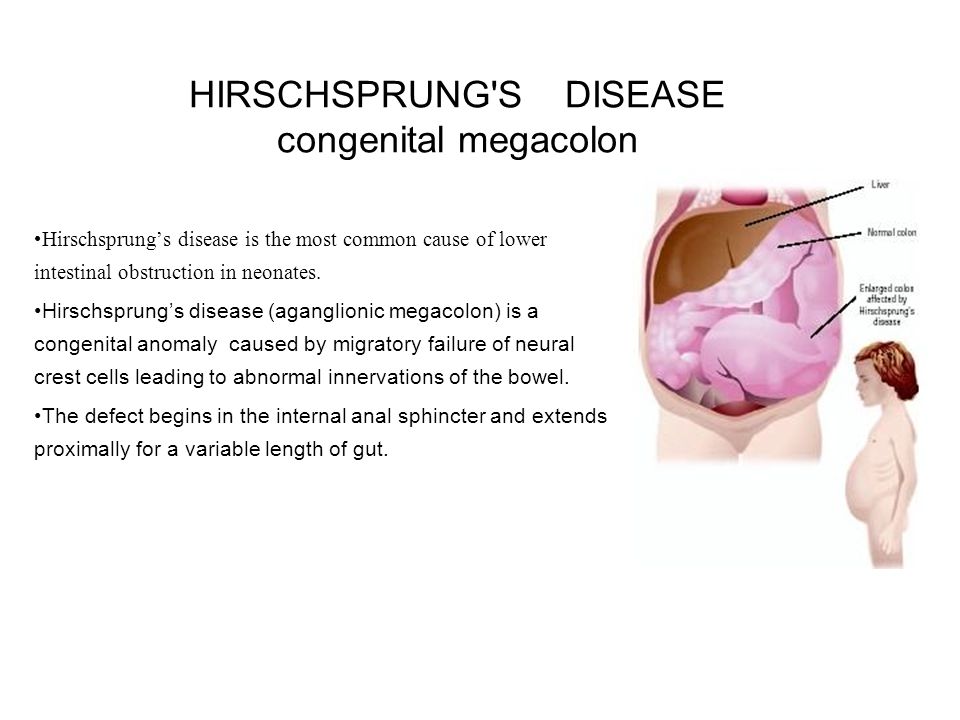
"Hirschsprung's disease, also called congenital megacolon or congenital aganglionic megacolon, is a congenital disorder of the large intestine, characterized by absence or marked reduction of parasympathetic ganglion cells in the colorectal wall. Hirschsprung's disease appears to be a familial, congenital defect, occurring in 1 in 5,000 to 1 in 8,000 live births. It's up to 7 times more common in males than in females (although the aganglionic segment is usually shorter in males) and is most prevalent in whites. Total aganglionosis affects both sexes equally. Females with Hirschsprung's disease are at higher risk for having affected children. This disease usually coexists with other congenital anomalies, particularly trisomy 21 and anomalies of the urinary tract such as megaloureter."


Image taken from: http://slideplayer.com/slide/7541905/24/images/1/HIRSCHSPRUNG+S+DISEASE+congenital+megacolon.jpg


According to the Mayo Clinic (http://www.mayoclinic.org/diseases-conditions/hirschsprung's-disease/home/ovc-20214664), the symptoms of Hirschsprung's Disease are included but not limited to,


"Hirschsprung's (HIRSH-sproongz) disease is a condition that affects the large intestine (colon) and causes problems with passing stool. The condition is present at birth (congenital) as a result of missing nerve cells in the muscles of the baby's colon.

A newborn who has Hirschsprung's disease usually can't have a bowel movement in the days after birth. In mild cases, the condition might not be detected until later in childhood. Uncommonly, Hirschsprung's disease is first diagnosed in adults.

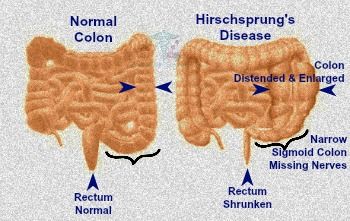
Surgery to bypass or remove the diseased part of the colon is the treatment."


Image taken from: http://www.birth-defect.org/wp-content/uploads/7f5592e639cf5afb772e168b4a153572.jpg


However, even though it is rare or uncommon, adults can very much get it as well.


The symptoms, according to Mayo (http://www.mayoclinic.org/diseases-conditions/hirschsprung's-disease/symptoms-causes/dxc-20214666), are,

"Signs and symptoms of Hirschsprung's disease vary with the severity of the condition. Usually signs and symptoms appear shortly after birth, but sometimes they're not apparent until later in life.

Typically, the most obvious sign is a newborn's failure to have a bowel movement within 48 hours after birth.


Other signs and symptoms in newborns may include:

Swollen belly

Vomiting, including vomiting a green or brown substance

Constipation or gas, which might make a newborn fussy

Diarrhea


In older children/adults, signs and symptoms can include:

Swollen belly

Chronic constipation

Gas

Failure to thrive

Fatigue


It's not clear what causes Hirschsprung's disease. It sometimes occurs in families and might, in some cases, be associated with a genetic mutation.

Hirschsprung's disease occurs when nerve cells in the colon don't form completely. Nerves in the colon control the muscle contractions that move food through the bowels. Without the contractions, stool stays in the large intestine.


Factors that may increase the risk of Hirschsprung's disease include:

Having a sibling who has Hirschsprung's disease. Hirschsprung's disease can be inherited. If you have one child who has the condition, future biological children could be at risk.

Being male. Hirschsprung's disease is more common in males.

Having other inherited conditions. Hirschsprung's disease is associated with certain inherited conditions, such as Down syndrome and other abnormalities present at birth, such as congenital heart disease."


Image taken from: http://www.medindia.net/images/common/patientinfo/950_400/abdominal-x-ray-can-helps-to-diagnose-the-hirschsprung-disease.jpg


According to MedicineNet (http://www.medicinenet.com/hirschsprung_disease/article.htm,

"The cause of Hirschsprung disease is due to nerve cells that are supposed to grow along the intestine and reach the anus, but do not because they stop growing too soon. Hirschsprung disease (HSCR) is a congenital (present at birth) disease of the large intestine or colon. It is one type of birth defect. People with the disease do not have the nerve cells in the intestine required to expel stools from the body normally.

Some people inherit the disease, and others have mutations in several genes. In about 50% of people with Hirschsprung disease, researchers and doctors do not know what genes cause it.

Your primary care doctor will refer you to a specialist in digestive disorders called a gastroenterologist, to diagnose the condition. Diagnosis for Hirschsprung’s is based on a physical exam, medical and family history, symptoms, and tests, for example, a digital exam.
Surgery is the treatment for this life-threatening disease (procedures include pull-through for infants and ostomy (An ostomy refers to the surgically created opening in the body for the discharge of body wastes) for toddles and older children).

After healing from surgery, your child's bowel movements may become normal. But surgery doesn't cure Hirschsprung disease. Some children/adults will have bowel problems – like constipation or fecal incontinence (“accidents”) – off and on throughout their lives.


Symptoms of Hirschsprung disease in toddlers and older children may include:

Not being able to pass stools without enemas or suppositories. An enema involves flushing liquid into the child’s anus using a special wash bottle. A suppository is a pill Placed into the child’s rectum.

Swelling of the abdomen.

Diarrhea, often with blood.

Slow growth.

Intellectual disability"


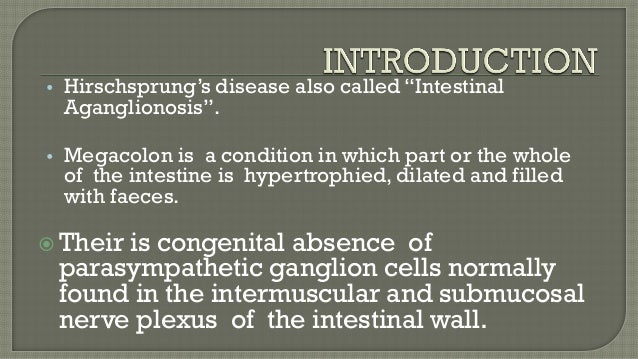
Image taken from: http://image.slidesharecdn.com/hirschsprungsdisease-140510235224-phpapp01/95/hirschsprungs-disease-3-638.jpg?cb=1399767420


According to Science Direct (http://www.sciencedirect.com/science/article/pii/S2237936315000519,

"Some patients reach adulthood without a diagnosis for this disease. Typically, patients go to the doctor with a long-standing history of constipation requiring frequent laxative use.11 The current frequency of the disease in adults is unknown, especially since HD is an overlooked and misdiagnosed disease in this age group. ...the diagnosis of HD is supported by barium enema studies, anorectal manometry and rectal biopsy.

Imaging studies such as computed tomography (CT) and barium enemas are usually accepted for evaluation of chronic constipation, which is a common disorder in adults. Our patient underwent CT due to the unavailability of a barium enema study, but CT is a more expensive method.

The anorectal manometry, even though not contributing in the present case, is an ancillary test of the utmost importance, since the presence of the rectum-anal reflex in this exam usually rule out the diagnosis of HD.

Several procedures are used to manage this disease after childhood; currently the option of choice is the surgical procedure of Duhamel. Late diagnosis contributes to the need for surgery in more than one surgical time, with ileostomy or colostomy, since the healthy colon is more distended in adolescents and adults compared to neonates and children. Nevertheless, the literature considers as the procedure of choice the Duhamel technique in only one surgical time, which reduces the hospitalization time.

This surgery is considered curative. However, post-operative bowel functioning is not always satisfactory. Enterocolitis, constipation and fecal incontinence represent the main postoperative complications in children. To date, the progression for adolescent or adult patients is not fully clarified yet, due to the small number of reported cases."


Image taken from: https://i.pinimg.com/736x/80/76/5d/80765d68dfe49fd160965c6aa5410100--menu-google-search.jpg


I really hope this will help educate you about Hirschsprung disease. I am still learning about it myself. The research I did says it is more likely to happen with children, but adults I know have it and were just officially diagnosed. After you have a rectal biopsy (because doctors do a biopsy to verify you do have HD), then they might do an anorectal manometry (which is where they stick a balloon up your rectum, kind of like the pelvic floor test). Once all of that has been confirmed, then they might start talking reconstructive pelvic surgery.


I would still advise you to be cautious, do your own research, talk to people who have had it done, and make an informed decision so you will know if this is right for you. Thank you very much to my friend who brought this illness to my attention, because I had no idea this was going on. My heart goes out to all of you who are fighting this on a daily basis.

Thursday, May 9, 2013

pH Probe Test - Mayo Visit Day 1

Well, I went to Mayo this morning and had the pH probe test done. I sat down and the nurse explained the test to me. The probe will test my vomit for bile, stomach acid, regurgitation, etc. This test will help the doctor determine how best to treat me. She had me sit facing her while she inserted the small catheter into my nose, down my throat, and into my stomach. She didn't use any numbing agents or anything before she put the catheter in. My eyes watered like crazy and she gave me water to sip on while she was inserting the catheter, to make it easier for me not to gag.

Once the catheter was in, the nurse secured it with tape. However, I do not believe it's secured that well because the tube tends to move in and out of my nose with every bump in the car, swallow, or movement. It's going to take some getting used to.


Illustration of where the pH Probe goes.


The nurse told me that I needed to take in three meals to ensure an accurate test. I'm not able to eat that much on the best of days, so this is going to be a real challenge for me.

She gave me a receiver that I have to wear, much like the Bravo Test that I had before. The receiver has three buttons that I need to press when I take my Aciphex, if I have heartburn, and if I experience regurgitation. I have to press another button when I eat and when I finish eating as well as when I lay down or up and about. The catheter is attached to this receiver, so I can't leave it on the bed or anything. I MUST carry it with me.


The receiver I have to carry with me.


So, I will wear the pH probe until tomorrow morning. I've got to eat in the morning, which will be difficult because that's when I'm the most sick. The nurse said she'd take it out before I see the doctor in the morning for the results.

My nose is really irritated and I keep sneezing. The tube keeps gagging me but other than that, it's not to bad. I prefer the Bravo Test though.


My pH probe!


Saturday, April 13, 2013

IBS Specialist or Gastroenterologist - What's the Difference?


IBS Specialist or Gastroenterologist: What’s the Difference?

**note: I wanted to thank Melissa "Missy" Culp for finding these articles and for asking intriguing questions on the Gastroparesis Facebook Page. She was my inspiration for my article, so I would like to name her a co-author.


There are IBS Specialists and there are Gastroenterologists.

IBS specialists are experts in IRRITABLE BOWEL SYNDROME (IBS). A gastroenterologist may diagnose IBS, but that will only tell you what you already know, that your bowel irritates you.

To the IBS specialist the label of IBS only serves as a starting point for further investigation, nothing more. The IBS specialist focuses on assessing and diagnosing the cause of your digestive problems, not on the gross structural integrity of the digestive tract. Rather than focusing on the patients symptoms, or simply treating the symptoms, the IBS specialist is devoted to identifying the condition or conditions in the patient that are causing the symptoms.


What Exactly Does a Gastroenterologist Do?

People often make assumptions about medical specialists and their areas of expertise. This is certainly true with gastroenterology, where many people assume that gastroenterologists are experts in all things related to the digestive tract.

Gastroenterologists are experts in diseases of the digestive tract, not syndromes or symptoms. While Gastroenterologists do primarily pay attention to the digestive tract, there are some surprising gaps in their training on the science of digestion. Gastroenterologists primarily focus on performing colonoscopies and upper endoscopies.

They may also do other imaging work of the GI tract, such as an ultrasound, CT scan,MRI, x-rays, and even “pill cameras.” And they may perform studies that assess the motility of the digestive tract. Therefore, if you go to a gastroenterologist your diagnosis will be based on this testing.

Gastroenterology is primarily a specialty in assessing the structure of the digestive tract. Gastroenterologists are focused on diagnosing ulcers, polyps, cancers, and other physically apparent abnormalities of the digestive tract. Surprisingly, they do not have training in nutrition or most reactions to foods. And though the digestive tract is the single most concentrated area of immune activity, gastroenterologists have no special training in immunology.


What Does an IBS Specialist Do?


There are literally hundreds of different causes of IBS and the digestive problems associated with IBS. An IBS specialist does not have any idea about how they will treat an IBS patient when they first meet that patient. Patients with identical symptoms may have radically different causes for those symptoms. An IBS specialist focuses on the detective work required to develop the proper treatment plan for each unique patient.


This process involves a detailed evaluation of how the body is responding to the foods in the diet (food allergies, intolerances, and sensitivities), and a thorough assessment of the profound ecosystem (including probiotics, yeast, bad bacteria, and parasites) that is contained within the digestive tract. It may also involve evaluating enzyme production, acid production, and the overall functioning of the digestive tract.


IBS specialists do not do what gastroenterologist do, and gastroenterologists do not do what IBS specialists do. These are completely different specialties. There is only a very tiny amount of overlap with regard to stool testing. But even this is extremely minor as the IBS specialist utilizes much more advanced stool analyses.


If you have IBS and continue to see gastroenterologists, then you will continue to get the same kind of testing and treatment that you’ve always received, even if you go to the Mayo Clinic, or the Cleveland Clinic, or any other big name medical facility or highly regarded expert – because they have a “standard of care” that recommends limiting testing. If that hasn’t helped, or you’d simply like to begin your journey with a different approach, then you need to see an IBS specialist. Your experience will be very different, which makes it far more likely that the outcome will be very different.


If you suffer from Irritable Bowel Syndrome, you need an IBS specialist. The link to the article can be found HERE.


My friend Melissa, suggested to me, that it would idea to follow a FODMAP DIET. The article about the Fodmap Diet says,

"The FODMAP theory holds that consuming foods high in FODMAPs results in increased volume of liquid and gas in the small and large intestine, resulting in distention and symptoms such as abdominal pain and gas and bloating. The theory proposes that following a low FODMAP diet should result in a decrease in digestive symptoms. The theory further holds that there is a cumulative effect of these foods on symptoms. In other words, eating foods with varying FODMAP values at the same time will add up, resulting in symptoms that you might not experience if you ate the food in isolation. This might explain the mixed results of studies that have evaluated the effects of fructose and lactose, two types of carbohydrates, on IBS. Ongoing research is being conducted as to the accuracy of the FODMAP theory and the effectiveness of the diet for IBS. Research into its effectiveness for IBS is at a very preliminary stage and it is unknown at this point if following such a diet would be safe for your health over the long term. As with any new treatment or dietary approach, it is always best to discuss the issue with your own personal physician."


Common High FODMAP Foods for IBS:

Fruits:

Apples
Apricots
Cherries
Mango
Pears
Nectarines
Peaches
Pears
Plums and prunes
Watermelon
High concentration of fructose from canned fruit, dried fruit or fruit juice

Grains

Level of FODMAPs is increased when these foods are eaten in large amounts:

Rye
Wheat

Lactose-Containing Foods

Custard
Ice cream
Margarine
Milk (cow, goat, sheep)
Soft cheese, including cottage cheese and ricotta
Yogurt

Legumes

Baked beans
Chickpeas
Lentils
Kidney beans

Sweeteners

Fructose
High fructose corn syrup
Isomalt
Maltitol
Mannitol
Sorbitol
Xylitol

Vegetables

Artichokes
Asparagus
Avocado
Beets
Broccoli
Brussel sprouts
Cabbage
Cauliflower
Garlic (with large consumption)
Fennel
Leeks
Mushrooms
Okra
Onions
Peas
Radiccio lettuce
Scallions (white parts)
Shallots
Sugar snap peas
Snow peas

Common Low FODMAP Foods

Fruits

Banana
Blueberry
Grapefruit
Grapes
Honeydew melon
Kiwi
Lemon
Lime
Mandarine oranges
Orange
Raspberry
Strawberry

Sweeteners

Artificial sweeteners that do not end in -ol
Glucose
Maple syrup
Sugar (sucrose)

Lactose Alternatives

Butter
Hard cheese, brie and camembert
Lactose-free products, such as lactose-free ice cream and yogurt
Gelato
Rice milk
Sorbet

Vegetables

Bell peppers
Bok choy
Carrots
Celery
Corn
Eggplant
Green beans
Lettuce
Parsnip
Scallions (green parts only)
Sweet potato
Tomato

Grains

Oats
Gluten-free products
Spelt products


Now I want to get into SIBO. If you have Gastroparesis, SIBO is a legit concern. Crystal Saltrelli wrote an article about SIBO not too long ago. Here is an exert of her article about SIBO if you would like to read it,

"What is SIBO? SIBO stands for small intestinal bacterial overgrowth. It’s also sometimes called small bowel bacterial overgrowth or SIBO. It all means the same thing: there are bacteria in your small intestine that are not supposed to be there. What causes SIBO? One of the biggest risk factors for SIBO is… slow gut motility. Muscular contractions within the gut are supposed to sweep things, both food and bacteria, through the GI tract. When it doesn’t, bacteria can take hold and multiply in places where they don’t belong. This is bad news for GPers, of course, and even worse if you’re chronically constipated, as bacteria may migrate upward from the colon to the small intestine, as well. What’s more, it’s thought that protein pump inhibitors (PPIs), which many GPers are immediately prescribed, may encourage the growth of bacteria by limiting (or even eliminating) the anti-bacterial effects of acid in the stomach."


You can find Crystal's Article by clicking HERE.


The link to the article can be found >HERE.

Friday, January 18, 2013

Detox - Day 3

I've been off of most of my medications for a few days now. The only ones I'm taking are Zanaflex 4mg, Phenergan 25mg, Ambien 5mg, Zofran 4mg, Xanax 0.05mg, and I'm weaning myself off of the Zoloft and Nortriptyline, since I can't just stop those cold turkey.

I need to ask the doctor for something stronger for insomnia. The Ambien 5mg just doesn't really work for me. I also need to ask the doctor if he could up my dose of Xanax for this month because just thinking about the future gives me a panic attack. I am so anxious that they aren't going to find anything or if they do, it will be horrible.

I also have really, really intense stomach spasms. They come in waves and all I can do is double over and not move. I try to breathe through them but that doesn't really help. It's almost like having a charlie horse in my abdomen. All I had today was a tiny bit of chicken and a small helping of rice. After I ate that, it took about thirty minutes for the gastric spasms to start.

The headache is also still lingering but I'm not sure if that's from dehydration or if it's from detoxing from all of the medications I'm not longer taking. I'm so exhausted and so weak. I've been sleeping a lot in the past few days because I'm just worn out. I thought about trying to finish some of my short stories and send them to publishers as a collection to see if anyone would publish them. I have great vivid dreams that would make amazing stories but I'm out of practice in writing. I've been writing research papers the past few years, so I am out of practice with creative writing. It would make me happy to have something of mine published. When I was a kid, I remember wanting to be a writer. It seems now that with all of the social media, my writing has dumbed down and I need to fix it.

I also need to write down my personal GP story for a book my friend LaShelle is putting together on GASTROPARESIS PAGE. She wants to make a Chicken Soup For the Teenage Soul but with Gastroparesis. It's been a long time since I've written like that. The last time I was published, I was in high school and wasn't so out of practice.

I feel like I never want to eat again. That rice keeps giving me spasms every hour. It hurts so much and the pain is intense.

I have been thanked for my blog, which makes me happy. It's actually helping people! I'm glad because that's part of the reason I started this. I didn't want people to take unnecessary medications or tests that people may not need. My blog has had over 6,000 views. I mean, that's amazing! Thank you all for reading my blog!

Another thing that's bothered me a bit. People keep telling me how strong I am. I don't always feel so strong. I feel so weak compared to the other admins on the GASTROPARESIS FACEBOOK PAGE. I mean, I try to be my own advocate but most of the time I just feel like I'm being whiny or annoying my friends with my blog posts. This is how I cope with the added stress. I need to write and get it out.

Monday, January 14, 2013

First Visit at the Mayo Clinic at Jacksonville

I have to say that the Mayo Clinic is very efficient. I went and registered at the registration desk and then was called back by a nurse. She input my information into the computer and put in all of my medical history. Then, she sent me upstairs to the floor where the doctor was and they asked me more questions and gave me more forms. I was able to get back to the doctor's room quite quickly.

As a side note, I need to make sure to get my other records sent there. I've had problems with nausea and vomiting since I was a teenager.

The doctor wasn't happy about my GI doctor's medications that he put me on but did commend my doctor for sending me to the Mayo Clinic. He told me that Bentyl and Levsin are basically the same things and they can cause paralysis of the stomach. I was also told to stop Nortriptyline, Dexilant, and Zoloft. The Doctor said that he wanted to see how my stomach reacted without all of the drugs masking symptoms and that the drugs could be making the nausea/vomiting worse. He told me that 30% of people that take Zoloft have nausea and vomiting.

He wanted me all of all of these medications before I take any tests. He doesn't want the medications to skew the results. So, I have to go back down to Jacksonville the first week of February.

He also said that me not being able to keep down water was very strange and not a symptom of GP. He mentioned this many times.

The doctor said that if the gastroparesis was caused by a virus in March, then the good news is that it is temporary - the stomach will heal itself in a year or two.

The tests that I will be doing the first week of February at Mayo are:

Gastric Emptying Test - to retake again because he said that they shouldn't have taken it the first time around while I was hospitalized and on pain medication. I will have this test done for four hours and I'm nervous because I had such a hard time keeping the radioactive sandwich down the first time. I remember crying because I was in so much pain from the test. Going from eating nothing to eating an entire sandwich is rough.

Endoscopic Ultrasound (they can't do an MRI with my spinal cord stimulator) - they want to go in to see if there are any stones or anything in my liver that could be causing my upper right pain. They are also going to stretch out my esophagus if they feel it's too constricted while they're in there. The doctor wants to take a look at my biliary system.

Bravo pH Test - this will test for acid reflux to see if that's contributing to my problems.

Blood tests - he's going to check my liver enzymes, since they've been elevated lately. He wants to know why. He's also testing my TSH (thyroid), Cortisol levels, and doing a complete panel.

The doctor has low confidence in my GP diagnosis and GERD. He thinks that if I do have gastroparesis that something else is going on because I shouldn't be this ill. This doctor helped to make the first gastric pacemaker, so I'm in good hands. He was also wearing a bow tie and I was wearing a Doctor Who shirt, with a TARDIS on it.

I have a test on each day starting February 4th. I'm going to be extremely tired but at least they're going to do it out patient. I'm hoping that I can get some answers. I really want to feel better and not carry a bucket or bags when I go anywhere.

Thursday, October 4, 2012

Research sheds light on debilitating medical condition

Researchers from the Auckland Bioengineering Institute (ABI) have accurately mapped the patterns of abnormal gastric electrical activity that occurs during gastroparesis, a debilitating stomach condition.

Dr Gregory O'Grady, from the Auckland Gastrointestinal Research Group based at the ABI, says the new findings provide for the first time an accurate and detailed description of gastric dysrhythmias in humans that will help in the development of new diagnostic and treatment options.

Gastroparesis, which affects predominately women and 10 per cent of diabetics, is a medical condition that affects the stomach's ability to empty itself resulting in a reduced quality of life due to chronic nausea, vomiting, abdominal bloating and pain.

Abnormal electrical activity in the stomach or gastric dysrhythmias was known to be associated with gastroparesis but until now no accurate descriptions of these abnormalities existed, says Dr O’Grady.

“This is because previous research had been impeded due to there being no adequate methods to investigate gastric electrical activity,” he says.

The research project involved surgeons, engineers and biomedical scientists from The University of Auckland, the Mayo Clinic in the US, and The University of Mississippi.

The Gastrointestinal Group’s research, which was published in the prestigious international medical journal Gastroenterology, required several years of technical development.

“We developed new clinical devices consisting of sheets of hundreds of electrodes that could be laid over the stomach to precisely track electrical patterns during surgery. A new software platform for processing these patterns also had to be developed by the research team, says Dr O’Grady.

“Gastroparesis is a devastating disease that is particularly difficult to diagnose and treat, and its causes have been poorly understood. Our research provides significant new insights into the disease, and opens the door to advanced new treatment options such as the use of gastric pacemakers, he says.

“We hope that over the next few years our devices will evolve into routine clinical tools for diagnosing gastroparesis as well as other significant disorders of stomach function,” says Dr O’Grady.

The research programme was led for many years by the late Professor Andrew Pullan, a principal investigator with the ABI and a member of the Department of Engineering Science within the Faculty of Engineering, who passed away earlier this year.

The research is continued by Dr O’Grady, and the other lead investigators of the study Drs Leo Cheng and Peng Du from the ABI and Professor John Windsor from the Faculty of Medical and Health Sciences.

The research was funded primarily by a project grant from the Health Research Council of New Zealand (HRC).

The University of Auckland

The Link is HERE.

Also, I feel this way right now:


Monday, June 18, 2012

Woke up at 6am - and My Stomach Hates Me

My stomach managed to wake me up and I went straight to the bathroom and vomited. So much for that. I thought I was having a good day yesterday. I vomited up some of the food that I ate at the wedding reception, some of it wasn't digested (OK, I know that's probably TMI - but my blog is to help keep track of these things to tell the doctor). I have very intense stomach cramps. I also feel very tired, exhausted, and fatigued even though I slept yesterday and some last night.

I just took:

1 pain pill

2 anti-spasmotic pills

1 anxiety pill

1 muscle relaxer

2 anti-nausea pills

Between all of those, and I hope I can keep those down, hopefully I'll go back to sleep. I just hate waking up with that immediate need to be sick. And, as per usual, I whacked my knee on the side of the toilet again.

I just want to feel better. I'm going to call and make an appointment with the motility specialist. She's at Crawford Long, so that's a bit closer to me to get to. When I do drive, I have to drive around with a bucket. I've gotten pretty good at vomiting outside of moving cars though. I don't feel safe driving because I might get sick while I'm driving.

I need to find a primary care doctor closer to my house as well. I feel bad just walking in and saying, "Hey, I've got gastroparesis and I'm your new patient!" I would like all of my records in one place, though. My knee records, my stomach records, my records from my old primary care doctor. I feel as though my medical records are scattered all across Atlanta.

I have to say that it was good to leave the house for a little bit. I've been confined here since March since my GP has been so severe. I slept on the car ride back because the nausea started to hit. Then, I went to bed and didn't wake up until about 10pm or so. This new medication knocks me out.

The medicine that helps the most is the muscle relaxer. It relaxes my stomach enough for me to eat and not be in as much pain.I don't know if they'll keep me on it or not but it's the only thing that seems to help.

Maybe one day this Summer, I will get to go to the beach! I miss the salty smell of the air... there's nothing quite like it. I'm leaving Wednesday or Thursday for a car ride up to Connecticut for convention for my fraternity with my friends. I hope that I can make it up there with no problems. I'm more worried about the car ride. If I don't eat while at convention, I won't be sick. I know that sounds absolutely horrible. I didn't each much before or after the wedding, so I didn't get sick like normal. So, I'm going to have to monitor myself very closely with food. Most of the time, I'm not hungry anyway. But, social conventions seem to be centered around food and drinking. I can't do either.