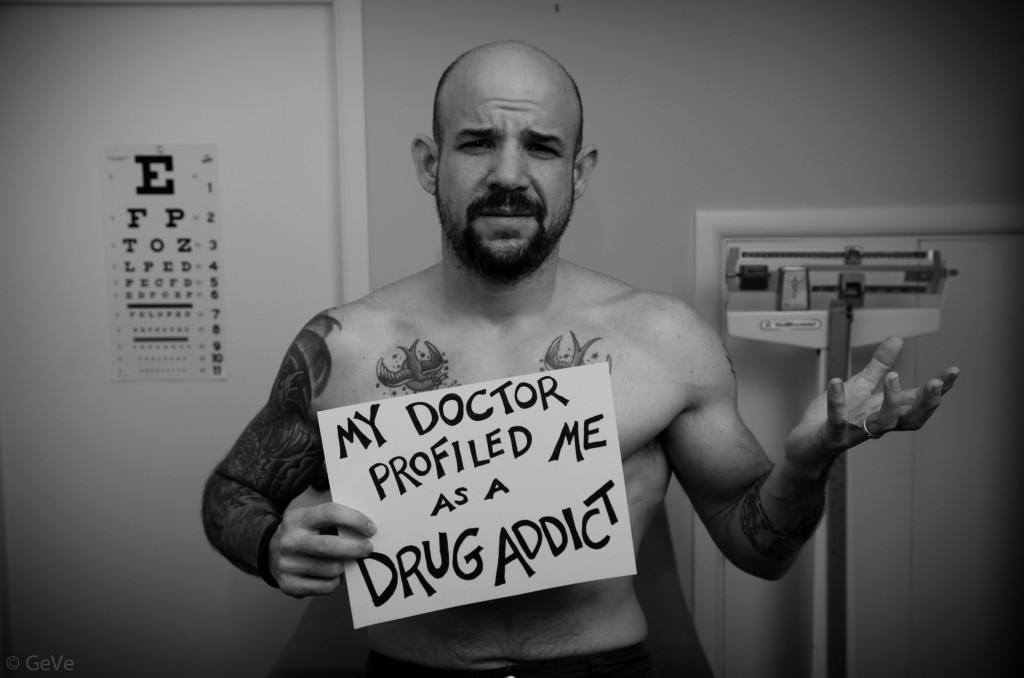
ADDICTS USING GASTROPARESIS IN ORDER TO ABUSE PRESCRIPTION DRUGS.
I have heard story after story from people with chronic pain, invisible illnesses, and issues that illustrate why it is terrible for healthcare professionals to make snap judgments. They treat chronically ill patients as drug seekers. It can be life threatening if healthcare professionals just write someone off as a drug seeker without evaluating them. I just want to ask the doctors, "do drug addicts not have medical emergencies, too?" Patient profiling has become a REALLY big problem in our healthcare system, as has the "opioid epidemic."
I have written two articles on chronically ill patients being treated as drug addicts, and you can find them here:
GASTROPARESIS PATIENTS VS DRUG SEEKERS.
INVISIBLE EMERGENCIES SERIES PART THREE.
First of all, let me define patient profiling. According to Kevin MD,
"Patient profiling is the practice of regarding particular patients as more likely to have certain behaviors or illnesses based on their appearance, race, gender, financial status, or other observable characteristics. Profiling disproportionately impacts patients with chronic pain, mental illness, the uninsured, and patients of color. Like racial profiling by police, patient profiling by physicians is more common than you think.
We rely on doctors to first do no harm–to safeguard our health–but profiling patients often leads to improper medical care, and distrust of physicians and the health care system, with potential lifelong consequences."

Can You Sue A Doctor For Patient Profiling?
According to Find Law,
"By Ephrat Livni, Esq. on April 01, 2016 3:55 PM
Patient profiling is a term used to describe a kind of discrimination by doctors. When a healthcare provider treats a patient based on their "type" rather than assessing them individually, that is profiling, and it can lead to problems in treatment.
Doctors should assess each patient individually, but profiling alone is not likely going to be a basis for a lawsuit against a doctor or hospital, unless that profiling manifested in medical malpractice. So let's explore the distinction between profiling, which is certainly unpleasant, and negligence law, which is based on actual injury.
Patient Profiling Primer
Dr. Pamela Wible, writing for Med Page Today's blog, Kevin MD, discusses and defines patient profiling. She explains, "Patient profiling is the practice of regarding particular patients as more likely to have certain behaviors or illnesses based on their appearance, race, gender, financial status, or other observable characteristics."
"Profiling disproportionately impacts patients with chronic pain, mental illness, the uninsured, and patients of color. Like racial profiling by police, patient profiling by physicians is more common than you think," Dr. Wible writes. "Profiling patients often leads to improper medical care."
That is where profiling starts to meet negligence in medicine. But there is still a distinction, as a medical malpractice suit must be predicated on an injury or harm that is compensable.
Medical Malpractice
Medical malpractice is a form of negligence for medical professionals. Negligence in medicine manifests in errors in diagnosis, treatment, or illness management, for example.
If any of these are the cause of an injury to the patient and it can be proven that the doctor's failures led to it, and that there were no unforeseeable intervening causes, then you have proven part of a claim. You must also show and that this harm can be compensated.
Now, if a doctor's negligence arose as a result of patient profiling, and you were harmed then the doctor's profiling, to the extent it can be shown, will help prove your malpractice claim. But profiling and negligence are not the same and one does not necessarily lead to the other, although it may be a strong sign that malpractice will arise if you are profiled as a patient.
Talk to a Lawyer
If you were treated poorly by a medical professional and were injured as a result, speak to a lawyer. Many personal injury attorneys consult for free or a minimal fee and will be happy to assess your claim."

Failed/Erroneous Diagnosis and Treatment
"We all tend to trust our doctors. After all, they’re the experts. Even though we have some of the best doctors in the world, even they can make a mistake. And these mistakes can be a lack of treatment or the wrong treatment. These can be confusing concepts, so here is a brief overview on failed or erroneous diagnoses and treatments in medical malpractice cases.
Medical Misdiagnosis Generally
In most cases, if a delay or failure to diagnose a disease has resulted in injury or disease progression above and beyond that which would have resulted from a timely diagnosis, medical professionals could be held liable. Most doctors are trained to think and act by establishing a "differential diagnosis." Doing so calls for a doctor to list, in descending order of probability, his or her impressions or "differing" diagnoses of possible causes for a patient's presenting symptoms.
The key question in assessing a misdiagnosis for malpractice is to ask what diagnoses a reasonably prudent doctor, under similar circumstances, would have considered as potential causes for the patient's symptoms. If a doctor failed to consider the patient's true diagnosis on his/her differential diagnosis list, or listed it but failed to rule it out with additional tests or criteria, then the doctor is likely able to be sued for medical malpractice.
However, this situation may be difficult to prove. For example, a patient may allege that a doctor failed to timely diagnose a certain cancer, resulting in "metastasis" (spread of the cancer to other organs or tissues). But experts may testify that "micrometastasis" (spreading of the disease at the cellular level) may occur as much as ten years before a first tumor has been diagnosed, and cancerous cells may have already traveled in the bloodstream and lodged elsewhere, eventually to grow into new tumors. Therefore, it may be difficult in some cases to establish that a patient has suffered a worse prognosis because of the failure or delay in diagnosis.
Failure to Treat and Erroneous Treatment
If a patient is treated for a disease or condition that he or she does not have, the treatment or medication itself may cause harm to the patient. This is in addition to the harm caused by the actual condition continuing untreated.
The most common way in which doctors are negligent by failing to treat a medical condition is when they "dismiss" the presenting symptoms as temporary, minor, or otherwise not worthy of treatment. This situation may result in a worsening of the underlying condition or injury, causing further harm or injury. For example only, an undiagnosed splinter or chip in a broken bone may result in the lodging of a piece of bone in soft tissue or internal bleeding caused by the sharp edge of the splintered bone.
Erroneous treatment is most likely to occur as a result of a misdiagnosis. However, a doctor who has correctly diagnosed a disease or condition may nonetheless fail to properly treat it. Other times, negligence is the result of a doctor attempting a "novel" treatment that fails, when in fact a more conventional treatment would have been successful.
Getting Legal Help with a Medical Malpractice Claim
Having an illness or injury is bad enough, without thinking our doctors made it worse. And it’s not always easy to know whether the professionals in charge of your medical care acted properly. If you would like to know more about your claim, you can contact an experienced medical malpractice attorney.
Medical Malpractice In-Depth
When illness or injury forces you to see a physician or go to the hospital, you can generally be assured that a medical professional's years of experience and training will result in excellent treatment. But in truth, medical care providers are only human, and errors are always possible. Medical malpractice occurs when a negligent act or omission by a doctor or other medical professional results in damage or harm to a patient. To get started with a medical malpractice case, read First Steps in a Medical Malpractice Claim. See FindLaw's Medical Malpractice section for more articles and resources.
Negligence by a medical professional can include an error in diagnosis, treatment, or illness management. If such negligence results in injury to a patient, a legal case for medical malpractice can arise against:
The doctor, if his or her actions deviated from generally accepted standards of practice;
The hospital for improper care or inadequate training, such as problems with medications or sanitation;
Local, state or federal agencies that operate hospital facilities.
Medical malpractice laws are designed to protect patients' rights to pursue compensation if they are injured as a result of negligence. However, malpractice suits are often complex and costly to win. Therefore, if you believe you have a medical malpractice claim, it is important to consult with an attorney who will discuss your case with you, and help you determine your best options.
Legislation Affecting Malpractice Actions
Due in part to the power and resources of health care industry lobbyists, many states have passed legislation making it more difficult to bring and prevail in medical malpractice actions. In most states today, physicians and hospitals are protected by legal limits, called "caps," on the amount of damages and attorneys' fees that can be awarded in malpractice suits. Also, most states have a two-year time limit for filing malpractice actions, unless extraordinary circumstances affect the case.
One obstacle plaintiffs in many states may have to overcome before they can even file a malpractice action against a health care professional is the requirement that they file what is commonly known as a "certificate of merit." In order to file a certificate of merit, a plaintiff will first have to have an expert, usually another physician, review the relevant medical records and certify that the plaintiff's health care provider deviated from accepted medical practices, which resulted in injury to the plaintiff. The plaintiff's attorney then files the certificate of merit, which confirms that the attorney has consulted with a medical expert and that the plaintiff's action has merit.
"Respondeat Superior" and Independent Contractors
Medical malpractice can be committed by several types of health care professionals and, in a case where a hospital employee commits malpractice, the hospital itself may be held liable under the legal doctrine of "respondeat superior." Under this theory, an employer may be held liable for the negligent acts of its employee if the employee was acting within the scope of his or her employment when the negligence occurred. This doctrine is very important to plaintiffs in medical malpractice cases, because it helps ensure there will be a financially responsible party to compensate an injured plaintiff.
In some situations, commonly involving attending physicians working in hospitals, health care providers are considered independent contractors rather than employees, which makes the doctrine of "respondeat superior" inapplicable. What this means is, if a doctor or other health care professional an independent contractor, and commits malpractice while treating a patient in a hospital, the hospital cannot be held liable for the doctor's negligence. However, the hospital can be held liable for its own negligence, for example, in granting attending privileges to an unlicensed or incompetent physician.
Seek Legal Help with a Medical Malpractice Attorney
It's not always easy to know how to pursue a medical malpractice case. A qualified medical malpractice attorney will be able to discuss the strengths and weaknesses of your case and help you get the compensation you deserve. A good first step is to contact a medical malpractice attorney."

According to Parent Professional,
"Have you ever heard of patient profiling? It takes place when medical–and mental health–professionals make an assumption about someone seeking care based on their appearance, race, gender, financial status or even the kind of illness they have, such as mental health or substance use problems. The first time I came across this was in an article written by Pamela Wible, MD (article below at the end of this article), who recounted patient stories where the personal judgment of a medical person resulted in poorer care. She worried that, similar to racial profiling by police, patient profiling is more common than we want to admit. And it undermines care.
When I first heard about patient profiling, I immediately thought of my younger son. A few years ago (when he was in his early 20s), he woke up on a Sunday morning with horrible vertigo, He couldn’t stand, couldn’t focus and couldn’t drive. I took him to the local emergency room where they asked a series of routine questions: Are you on any medication? (No.) Have you ever experienced this before? (No.) Have you had anything alcoholic to drink? (Yes, one beer last night with friends. I was the designated driver.) Unfortunately, the questions stopped after he said he had had that beer the night before. He was given intravenous fluids, allowed to rest and sent home. The next day, his very irate primary care doctor sent him to a different emergency room where he was treated for inflammation of the inner ear.
For my son, staff at the first emergency room decided that a young adult in his 20s experienced vertigo because he had been drinking. They made a snap judgment and his treatment was delayed. To this day, he feels a general mistrust of emergency room staff.
For children and youth with mental health needs and their families, patient profiling happens far too often. It happens in the emergency room and it happens in visits to medical specialists. One mom, whose daughter had both a diagnosis of depression and frequent migraines – for which she was seeing a specialist – waited four days recently in the emergency room because no inpatient beds were available. She was told that her daughter couldn’t receive migraine medication while waiting because that was drug seeking behavior And it was probably part of the bipolar anyway. The mother was frantic when she called us and very frustrated that her daughter’s care was all being lumped under mental health. She felt the emergency room staff had stopped their assessment of her daughter’s needs after they heard about the bipolar disorder.
This doesn’t just happen in emergency rooms. It happens with medical specialists who think that mental health concerns have caused medical symptoms. It happens when doctors call parents 'enmeshed' or 'co-dependent' and don’t see them as a resource and partner but instead as part of the problem. It happens when young people are seen as their diagnosis and not as a valuable self-reporter and critical thinker.
That said, there is a fine line between patient profiling that can help or harm. Doctors, nurses, therapists and other workers often form an initial impression based on their experiences or their training. They often need this starting point to determine a course of action. But – and this is the crucial piece – that starting point needs updating as new information comes in. A second impression or a third is often in order. When the initial judgment is incomplete or inaccurate and it is not revised, it can be harmful.
A cornerstone of good care is excellent communication. While this is often characterized as the doctor or medical professional communicating to the patient, it should be a two-way street. Mutual exchange of information is critical but so is mutual listening. In any human interaction, the only way we can truly connect is when we get past our snap judgments and see who is actually there.
When a child is in crisis or when her need for care is urgent, parents are rarely at their best. Most often, there have been many stressful days or weeks before this point which have worn them down. We rely on medical staff to see beyond the diagnosis to the whole child, teen or young adult. We trust them to see our commitment and strength in the midst of the frenzy. We hope they will see us as a key member of the team, not as a 'less than' parent to be held at arm’s length.
When this doesn’t happen due to patient profiling, we all lose."

According to the Daily Mail,
"Medical jargon is pretty impossible for most patients to follow, but some of the terms you hear your doctor use may just be insulting industry jargon.
Over decades, doctors have ad-libbed a whole vocabulary to encode their frustrations with problem patients, communicate grim status updates, or even gossip about children.
In medicine, this slang is more than harmless insider-jargon: studies have shown that doctors' attitudes and discrimination toward patients can have a real affect on the treatment they receive and how well they recover.
Medical schools have begun to recruit more diverse students in the hopes of changing the field's culture, but several young doctors who wished to remain anonymous told Daily Mail Online that discriminatory terms are still common.
But discrimination is institutionalized and dangerous in medicine, according to Dr Peter Muennig and Dr Alex Green of Harvard University and Massachusetts General Hospital, and it's worth knowing some of these terms that doctors may use to mask the severity of a situation or downright insult you (warning: some of these are offensive).
GOMER
This 'classic' term stands for 'get [them] out of my emergency room.' It has been used in hospitals for decades and is familiar to just about every doctor working, Dr Muennig says.
The acronym is a sort of catch-all term for any of the kinds of patients doctors don't want to deal with.
'There's a certain level of discrimination against the chronically ill, and that's where GOMER comes from,' says Dr Muennig.
In a recent interview with Daily Mail Online, he also said that this term is often used particularly to describe people who physicians suspect are hunting for pain medication.
Frequent fliers
Patients may return to the hospital week after week - or even day after day - for a variety of legitimate or illegitimate reasons, earning them the title 'frequent fliers,' but certainly no points from doctors.
Chronically ill patients with conditions like diabetes must make regular appointments for dialysis.
Other patients become common faces in emergency rooms and clinics because of their hypochondriacs tendencies, constantly sure that they are gravely ill.
Still other patients may just be looking for a drug fix, coming in with complaints of chronic pain, or in hopes that the physicians on shift will be more willing to prescribe than yesterday's were.
'It's most often used to talk about people with severe diseases like diabetes, or renal failure and diabetes,' says Dr Muennig.
FLK
Doctors use this cruel acronym for 'funny looking kid' to describe 'those babies who are "syndromic" or [we can tell] something is wrong with them based on how they look,' a Chicago doctor told Daily Mail Online.
Children born with any of the three trisomies - genetic mutations that cause there to be an extra copy or partial copy of a chromosome - often have distinct appearances.
These disorders include Down syndrome, which is typified by a flattened face, smaller head and ears than normal and upward slanting eyes.
Doctors also use the FLK to describe babies that don't have a clear diagnosis, but whose 'abnormal' appearance suggests that there may be something wrong with them.
Crumping
Not to be confused with the dance style, doctors use 'crumping' when they have a patient that is 'crashing, but not aggressively,' the Chicago doctor told Daily Mail Online.
The phrase is synonymous to 'circling the drain.' Rather than their organs suddenly failing - or crashing - these patients are deteriorating quickly, and often don't have much chance for survival.
'I don't think it's necessarily harmful to say "crumping" or "frequent flier,"' a New York-based doctor said, 'but I'm very careful as a physician to not use those words in earshot of a family, that would be strongly unprofessional.'
Total body dolores
Like many legitimate medical terms, this one is derived directly from Latin. 'Dolores' translates to pain so this 'literally means total body pain,' the doctor says.
The phrase is most often used between doctors, to describe a patient, as in, 'I have a total body dolores in room 109.'
He says he's seen this term used commonly to describe Latino patients in particularly. 'These patients can be very nervous,' he says, in part because English is often their second language, making the hospital and medical-speak even more frightening, 'and their anxiety manifests physically.'
Slang is used 'commonly with people of color, people using drugs,' he says. More common phrases like '"crack head" are commonly heard on the ward too.'
Although 'doloroes' means pain in Latin, a rather medical language, it means the same thing in Spanish, as well as being a woman' name. This all adds up to maximize confusion for patients.
Status dramaticus
A patient earns the title 'status dramaticus' when they are a '10/10 [for pain] always, although they look fine,' the Chicago doctor says.
'This is someone that wails shrieks, howls so loudly you can hear them from the hallways. Everything hurts and they make sure you know about it,' he says.
The problem with doctors using terms like status dramaticus, says Dr Alex Green, 'is that they're dealing with people who are sick, physically and sometimes mentally and these [dismissals] can be more directly harmful.'
WWWS
The acronym for 'wealthy white woman syndrom ' is 'actually bad because it's a term that is used when you're frustrated at specific patients and dismissing their symptoms,' says Dr Lisa Wang, a psychiatry resident in New York.
Research has documented that physicians are more likely to take women's pain less seriously than they would a man's. There is a widely held belief - though studies turn up mixed results - that women's bodies are designed for childbirth and their pain thresholds are higher.
A 2008 study from the National Institutes of Health also found that women wait 16 minutes longer to be seen in an emergency room than men do.
'As medical providers, on an unspoken level, I think [using these terms] is a coping mechanism, to make light of really difficult situations,' Dr Wang says.
HHS and Aye-aye-itis
Discrimination against people of color and those for whom English is a second language is rampant, as evidenced by the terms 'hysterical Hispanic syndrome' and aye-aye-itis.
'I hear "aye-aye-itis" used for a Hispanic patient who has many somatic complaints, none of which are related to their surgery or main problem, usually accompanied by "aye, aye,"' the Chicago doctor says.
'Language barriers are a big discriminatory factor,' says Dr Green.
'There's an attitude of "oh, another patient that doesn't speak English, why don't they learn, it makes our lives so difficult,' says Dr Green, who has worked on initiatives to educate hospitals on language barriers and introduce interpreters.
'I roll my eyes every time I hear that [kind of term]' says a New York doctor. 'I call it out because it gets at the rampant cynicism to the job.'
In one Harvard study, 20 percent of a group of 8,000 Latino people reported experiencing discrimination at a health care facility or clinic.
Slugging
'A slug is someone who is reluctant to get up out of bed after surgery,' says the Chicago doctor.
'They tend to be slow, in pain, and want to stay "one more day longer, please,"' he says.
On one hand, 'poor effort,' as he calls it, can have a negative impact on the quality and timeline for recovery, but there is a darker side to this tendency too.
A hospital bed might be the safest and most certain place some patients can stay, especially for those who are not financially secure or may be struggling with addiction.
'When you have patients showing up drunk every single night, always overdosing, not taking their blood pressure medications and coming in because of it, it becomes easy to blame patients, though I don't think you should,' says one New York doctor.
Dr Green says that 'a lot of it derives from [doctors'] systemic frustrations with the medical system back-firing back onto patients.'"
I have written a companion article with ALL of the medical slang, acronyms, etc. all on its own, because there is SO much of it. You can find the article: http://www.emilysstomach.com/2019/04/patient-profiling-medical-slang-only.html

According to Pamela Wible MD,
"Patient Profiling: Are You a Victim?
We rely on doctors to first do no harm–to safeguard our health–but profiling patients often leads to improper medical care, and distrust of physicians and the health care system, with potential lifelong consequences. For the first time, people share their stories:
'I was once denied pain meds after a fall off a 10-foot porch by the same doc who gave my pretty female friend pain meds after getting two stitches in her finger. I felt like my appearance had something to do with it.' ~ Jay Snider
'In 1986 I was in a motorcycle accident. I tore up my face on the road. I was taken to the ER and treated like crap because I had no insurance. They cauterized my facial wounds rather than stitch me up, and then dumped me on the sidewalk with amnesia. I still have distinct black scars; people think they’re tattoos. I went into collections and it took years to pay that one off. Six weeks ago, I fell while trimming a tree. When the ER found the insurance card in my wallet, I was treated like gold.' ~ James Cummings
'As a teen, I fractured my nose. Many sinus issues later, I consulted an ENT specialist. He insisted that I damaged my sinus passages by using cocaine. His assumptions caused me pain, humiliation, confusion, and anger. I repeatedly assured him that I wasn’t a user. Two surgeries later, my septum was removed. Afterwards, he was so cruel as to continue his tirade about my cocaine use. As the gauze was being removed from my nose, I fainted. When I was roused, he insisted that I leave immediately showing no concern about whether I could even make it home safely.' ~ Lonnie Stoner
'It was 1975. I was 23 and I’d been on the pill for 4 years, but I became concerned about potential negative side effects of long-term hormonal manipulation. So I researched other contraceptives and felt the diaphragm was the simplest and safest option for me. When I went to the county clinic to get fitted, I explained what I’d researched to the doctor. He scoffed at my concerns, urged me to stay on the pill, and disputed any potential negative consequences. He reminded me that taking a pill each day was SO much easier than having to be responsible for using the diaphragm properly. It was clear he thought I was too young and clueless to make this decision about my own reproductive health care. Although he tried to dissuade me from switching to a diaphragm, I insisted that’s what I wanted, and he finally fitted me for it. After he left the room, the nurse said, ‘Don’t worry, dear; it’s quite easy to use. I’ve been using one for years with no problems. It’s a good choice for you to make!’ It was clear she didn’t approve of his patronizing attitude either.' ~ Patsy Raney
'I injured my back at work. I couldn’t get time off, so my family doc prescribed pain meds so I could get through the day and Xanax for sleep. I returned every six months for two years and he always accused me of taking more than I was prescribed. He got progressively more rude and angry. I brought my wife with me to see if I was imagining it. She witnessed it too, so we searched for another doctor. I asked my new doctor to taper me off of the pain meds and Xanax so I could try medical marijuana instead. He was skeptical. He told me to go to the pain clinic. I’d gone there once before and was treated like a criminal. I didn’t want to go there! So he wrote up a contract that said I would agree to take pain meds and Xanax and I’d be drug tested monthly to make sure that I wasn’t using medical marijuana. When I told him I wouldn’t sign the contract, he told me to find another doctor. This was at a critical time when I needed real help and was worried about taking the meds for over two years.' ~ Carl Williams
I’ve been a doctor for 20 years. I thought I’d seen it all. Drug addicts have altered my prescriptions, even forged my name. Patients have lied to me. Many haven’t followed my treatment plans. Some have died as a result. Still, I try to treat everyone fairly and with respect. But now I’m wondering, “Have I ever profiled a patient?” I bet I have. So on behalf of my colleagues and myself, I’ve got a message for any patient who has ever been misjudged or mistreated:
Image Source: In Article

Special shout out to Chriss for her help.