Find us on Google+ Gastroparesis: mayo clinic

Copyright

“You agree that you will not modify, copy, reproduce, sell, or distribute any content in any manner or medium without permission."
Showing posts with label mayo clinic. Show all posts

Saturday, June 10, 2017

The Vagus Nerve Stimulator

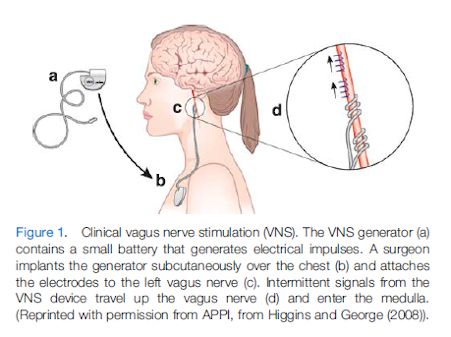
The Vagus Nerve Stimulator (VNS) is a medical treatment that involves delivering electrical impulses to the vagus nerve. The Vagus Nerve Stimulator, which is new to me so I wanted to do research on it, definitely would help a variety of conditions like epilepsy, depression, multiple sclerosis, headache, pain and Alzheimer's disease. It would probably even help with gastroparesis as well, though I'd check with your doctor first to be one hundred percent sure. Gastroparesis and DTP are caused by vagus nerve damage. If it sends electric impulses down your vagus nerve, it might help your stomach muscles contract and help with gastric emptying. There isn't enough research about Gastroparesis and the VNS so I cannot give you a definitive answer on whether it would help with Gastroparesis or not. However, I did research on the VNS itself, below, because I am not really familiar with it yet. I hope the research helps and I am going to mention this procedure to my GI to see if he would recommend it or if it can be used for Gastroparesis. It has been approved by the FDA for cluster headaches, which I found interesting reading the articles below.


If you are not familiar with the vagus nerve and how much it controls, please read my other article. The link is below:

http://www.emilysstomach.com/2016/07/information-about-vagus-nerve.html


Source: http://www.epilepsy.org.uk/sites/epilepsy/files/images/advice/vns_cyberonics.jpg


The Mayo Clinic describes the Vagus Nerve Stimulator (VNS) as:

"Vagus nerve stimulation is a procedure that involves implantation of a device that stimulates the vagus nerve with electrical impulses.

There's one vagus nerve on each side of your body, running from your brainstem through your neck to your chest and abdomen.

Vagus nerve stimulation is most often used to treat epilepsy when other treatments haven't worked. Vagus nerve stimulation is also a treatment for hard-to-treat depression that hasn't responded to typical therapies.

Researchers are currently studying vagus nerve stimulation as a potential treatment for a variety of conditions, including multiple sclerosis, headache, pain and Alzheimer's disease.

In conventional vagus nerve stimulation, a device is surgically implanted under the skin on your chest, and a wire is threaded under your skin connecting the device to the left vagus nerve. The right vagus nerve is not used because it carries fibers that supply nerves to the heart.

When activated, the device sends electrical signals along the vagus nerve to your brainstem, which then sends signals to certain areas in your brain.

New, noninvasive vagus nerve stimulation devices, which do not require surgical implantation, have been approved for use in Europe to treat epilepsy, depression and pain but have not yet been approved for use in the U.S. An implantable device that stimulates the right vagus nerve is also under study for the treatment of heart failure.


Before the procedure

Before surgery, your doctor will do a physical examination. You may need blood tests or other tests to make sure you don't have any health concerns that might be a problem.

Your doctor will have you start taking antibiotics before surgery to prevent infection.


During the procedure

Surgery to implant the vagus nerve stimulation device is done either on an outpatient basis, allowing you to go home that same day, or on an inpatient basis, requiring an overnight stay in the hospital.

The surgery usually takes one to two hours. You may remain awake but have medication to numb the surgery area (local anesthesia) or you may be unconscious during the surgery (general anesthesia).

The surgery itself doesn't involve your brain. Two small incisions are made, one on your chest and the other on the left side of the neck.

The pulse generator is implanted in the upper left side of your chest. The device is meant to be a permanent implant, but it can be removed if necessary.

The pulse generator is about the size of a stopwatch and runs on battery power. A lead wire is connected to the pulse generator. The lead wire is guided under your skin from your chest up to your neck, where it's attached to the left vagus nerve through the second incision.


After the procedure

The pulse generator is turned on during a visit to your doctor's office a few weeks after surgery. Then it can be programmed to deliver electrical impulses to the vagus nerve at various durations, frequencies and currents.

Vagus nerve stimulation usually starts at a low level and is gradually increased, depending on your symptoms and side effects.

Stimulation is programmed to turn on and off in specific cycles. You may have some tingling sensations or slight pain in your neck when the nerve stimulation is on.

Usually, the stimulations are set to occur every one to three minutes. Programming is performed at the physician's office using a hand-held programming device.

The stimulator doesn't detect seizure activity or depression symptoms. When it's turned on, the stimulator turns on and off at the intervals selected by your doctor.

You'll be given a hand-held magnet so that you can initiate a stimulation yourself if you or others sense the beginning of a seizure.

The magnet can also be used to temporarily turn off the vagus nerve stimulation, which may be necessary when you do certain activities such as public speaking, singing or exercising, or when you're eating if you have swallowing problems.

You must visit your doctor periodically to make sure that the pulse generator is working correctly and that it hasn't shifted out of position. Most people see their doctor once or twice a year for this purpose.

You should also contact your doctor before you have any medical tests, such as magnetic resonance imaging (MRI), which might interfere with your device, or have another medical device implanted.


Results

Vagus nerve stimulation isn't a cure for epilepsy. Most people with epilepsy won't stop having seizures or taking epilepsy medication altogether after the procedure.

But many will have fewer seizures, up to 20 to 50 percent fewer. Seizure intensity may lessen as well.

It can take as long as 18 months of vagus nerve stimulation before you notice any significant reduction in seizures. Vagus nerve stimulation may also shorten the recovery time after a seizure.

People who've had vagus nerve stimulation to treat epilepsy may also experience improvements in mood and quality of life.

Research is still mixed on the benefits of vagus nerve stimulation for the treatment of depression.

Some studies suggest the benefits of vagus nerve stimulation for depression accrue over time, and it may take several months of treatment before you notice any improvements in your depression symptoms.

In addition, vagus nerve stimulation doesn't work for everybody, and it generally isn't meant to replace traditional treatments.

Additionally, some health insurance carriers may not pay for this procedure.

Studies of vagus nerve stimulation as a treatment for conditions, such as Alzheimer's disease, migraine and multiple sclerosis, have been too small to draw any definitive conclusions about how well it may work for those problems. More research is needed."
Source: http://www.mayoclinic.org/tests-procedures/vagus-nerve-stimulation/home/ovc-20167755


In vagus nerve stimulation, an implanted pulse generator and lead wire stimulate the vagus nerve, which leads to stabilization of abnormal electrical activity in the brain.
Source: http://www.mayoclinic.org/tests-procedures/vagus-nerve-stimulation/multimedia/vagus-nerve-stimulation/img-20006852


According to Wikipedia, it has a lot of different medical uses such as,

"Because the vagus nerve is associated with many different functions and brain regions, research is being done to determine its usefulness in treating other illnesses, including various anxiety disorders, Alzheimer's disease, migraines, fibromyalgia, obesity, and tinnitus.

Alcohol addiction
Atrial fibrillation
Autism
Bulimia nervosa
Burn-induced organ dysfunction
Chronic heart failure
Chronic intractable hiccups
Comorbid personality disorders
Coronary artery disease
Dravet syndrome
Drop-attacks
Heatstroke
Heroin seeking behavior
Intestinal epithelial barrier breakdown
Lennox–Gastaut syndrome
Memory
Mood disorders in elderly population
Multiple sclerosis
Myocarditis
Obsessive compulsive disorder
Peripheral arterial occlusion disease
Postoperative cognitive dysfunction in elderly patients
Rasmussen's encephalitis
Severe mental diseases
Sepsis
Spinal trigeminal neuronal
Transient focal cerebral ischemia
Trauma-hemorrhagic shock
Traumatic brain injury
Vaginal-cervical self-stimulation in women with complete spinal cord injury
Vegetative states after traumatic brain injury
Visceral pain-related affective memory
Other brain stimulation techniques used to treat depression include electroconvulsive therapy (ECT) and cranial electrotherapy stimulation (CES). Deep brain stimulation is currently under study as a treatment for depression. Transcranial magnetic stimulation (TMS) is under study as a therapy for both depression and epilepsy. Trigeminal Nerve Stimulation (TNS) is being researched at UCLA as a treatment for epilepsy."


Unless you have a surgically implanted device you actually cannot directly stimulate your vagus nerve; however, you can indirectly stimulate your vagus nerve to relieve keyed up or shut down nervous system states. Remember, your vagus nerve passes through your belly, diaphragm, lungs, throat, inner ear, and facial muscles. Therefore, practices that change or control the actions of these areas of the body can influence the functioning of the vagus nerve through the mind-body feedback loop.


According to Dr. Arielle Schwartz, you can try these from the comfort of your living room:

"Humming: The vagus nerve passes through by the vocal cords and the inner ear and the vibrations of humming is a free and easy way to influence your nervous system states. Simply pick your favorite tune and you’re ready to go. Or if yoga fits your lifestyle you can “OM” your way to wellbeing. Notice and enjoy the sensations in your chest, throat, and head.

Conscious Breathing: The breath is one of the fastest ways to influence our nervous system states. The aim is to move the belly and diaphragm with the breath and to slow down your breathing. Vagus nerve stimulation occurs when the breath is slowed from our typical 10-14 breaths per minute to 5-7 breaths per minute. You can achieve this by counting the inhalation to 5, hold briefly, and exhale to a count of 10. You can further stimulate the vagus nerve by creating a slight constriction at the back of the throat and creating an “hhh”. Breathe like you are trying to fog a mirror to create the feeling in the throat but inhale and exhale out of the nose sound (in yoga this is called Ujjayi pranayam).

Valsalva Maneuver: This complicated name refers to a process of attempting to exhale against a closed airway. You can do this by keeping your mouth closed and pinching your nose while trying to breathe out. This increases the pressure inside of your chest cavity increasing vagal tone.

Diving Reflex: Considered a first rate vagus nerve stimulation technique, splashing cold water on your face from your lips to your scalp line stimulates the diving reflex. You can also achieve the nervous system cooling effects by placing ice cubes in a ziplock and holding the ice against your face and a brief hold of your breath. The diving reflex slows your heart rate, increases blood flow to your brain, reduces anger and relaxes your body. An additional technique that stimulates the diving reflex is to submerge your tongue in liquid. Drink and hold lukewarm water in your mouth sensing the water with your tongue.

Connection: Reach out for relationship. Healthy connections to others, whether this occurs in person, over the phone, or even via texts or social media in our modern world, can initiate regulation of our body and mind. Relationships can evoke the spirit of playfulness and creativity or can relax us into a trusting bond into another. Perhaps you engage in a lighthearted texting exchange with a friend. If you are in proximity with another you can try relationship expert, David Snarch’s simple, yet powerful exercise called 'hugging until relaxed.' The instructions are to simply 'stand on your own two feet, place your arms around your partner, focus on yourself, and to quiet yourself down, way down.'

Knowing practices for self-care are important. However, it is also important to know how and when to seek out professional therapeutic help. Asking for help can often be the hardest step. You do not need to walk the healing path alone."
Source: http://drarielleschwartz.com/natural-vagus-nerve-stimulation-dr-arielle-schwartz/#.WTxbvRPyvUo


Source: http://s-media-cache-ak0.pinimg.com/originals/fa/0b/55/fa0b55237c346fe50908d402f25b5d5a.jpg


The risks for the VNS, include side effects for the stimulator itself and surgical risks. According to the Mayo Clinic, they are,

"For most people, vagus nerve stimulation is safe. But it does have some risks, both from the surgery to implant the device and from the brain stimulation.


Surgery risks

Surgical complications with vagus nerve stimulation are rare and are similar to the dangers of having other types of surgery. They include:

Pain where the cut (incision) is made to implant the device
Infection
Incision scarring
Difficulty swallowing
Vocal cord paralysis, which is usually temporary, but can be permanent
Side effects after surgery

Some of the side effects and health problems associated with vagus nerve stimulation can include:

Voice changes
Hoarseness
Throat pain
Cough
Headache
Chest pain
Breathing problems, especially during exercise
Difficulty swallowing
Abdominal pain or nausea
Tingling or prickling of the skin
Insomnia
Slowing of the heart rate (bradycardia)
For most people, side effects are tolerable. They may lessen over time, but some side effects may be bothersome for as long as you use vagus nerve stimulation.

Adjusting the electrical impulses can help minimize these effects. If side effects are intolerable, the device can be shut off temporarily or permanently."
Source: http://www.mayoclinic.org/tests-procedures/vagus-nerve-stimulation/details/risks/cmc-20167760
Source: http://www.healthrising.org/wp-content/uploads/2015/05/Vagus-Nerve-Stimulation.jpg


EDIT September 28, 2017: A coma patient was comatose for fifteen years. Doctors placed a vagus stimulator in the coma patient and noticed that it increased the patient's brain activity. He woke up and can now communicate.

The article from The New York Post (http://nypost.com/2017/09/25/patient-in-coma-for-15-years-shows-signs-of-life-after-breakthrough/) says,

"A car crash victim left in a coma for 15 years has shown signs of life after a [vagus] nerve stimulator was implanted into his chest by neurosurgeons.

Doctors in France were able to stimulate nerves and have been able to challenge the long-held belief that disorders of consciousness that persist for longer than 12 months are irreversible.

Dr. Angela Sirigu of Institut des Sciences Cognitives Marc Jeannerod in Lyon said: 'By stimulating the vagus nerve, we show that it is possible to improve a patient’s presence in the world.'

The vagus nerve connects the brain to many other parts of the body, including the gut, and it is known to be important in waking up, alertness, and many other essential functions.


VNS stimulation was shown to revive consciousness in comatose patients.


Image Credit: http://nypost.com/2017/09/25/patient-in-coma-for-15-years-shows-signs-of-life-after-breakthrough/


To test the ability of vagus nerve stimulation (VNS) to restore consciousness, the researchers wanted to select a difficult case to ensure that any improvements couldn’t be explained by chance.

They looked at a patient who had been lying in a vegetative state for more than a decade with no sign of improvement.

The results, which were published in the journal Current Biology, show that after one month of VNS, the patient’s attention, movements and brain activity significantly improved.

PET scans show increased brain activity in comatose patients after VNS.

The patient began responding to simple orders that had been impossible before and was able to follow an object with his eyes and turn his head upon request.

The patient’s mother reported an improved ability to stay awake when listening to his therapist reading a book.

After stimulation, the researchers also observed responses to 'threat' that had been absent. For example, when an examiner’s head suddenly approached the patient’s face, he reacted with surprise by opening his eyes wide.

After many years in a vegetative state, he had entered a state of minimal consciousness.

Brain scans also showed major changes and improvements in movement, sensation, and awareness and also showed increased brain functional connectivity.


A positron emission tomography scan showed increases in metabolic activity in both cortical and subcortical regions of the brain.

The scientists say it shows that the right intervention can yield changes in consciousness even in the most severe clinical cases.

Sirigu said: 'Brain plasticity and brain repair are still possible even when hope seems to have vanished.'

The team now hopes the findings will also advance understanding of the capacity of our minds to produce conscious experience."


Saturday, July 13, 2013

Relaxation & Breathing Techniques from Mayo in Jacksonville

I know that this is a repost for me but I have better copies of the documents that you can actually read, now that I've scanned them in. The doctor told me that all of my issues stem from anxiety but I believe he's wrong. My anxiety didn't get worse until my stomach issues became worse. However, if you have issues sleeping or if you are having a panic attack, this will help. I've had to deep breathe out of panic attacks and talk myself out of it, especially in the car. I hope this will help you. Again, this was handed to me by Mayo but I wanted to save others thousands of dollars to be handed these pieces of paper.

If you click on the images, they'll open in PDF format so that you can read it better.

I apologize about the spill on the last two pages. I managed to spill soda on it while reading the sheets in the car when my husband jerked the wheel.


Tuesday, May 21, 2013

Relaxation Techniques from Mayo

I was told to learn Relaxation Techniques from Mayo, so I'm going to share them with you. If you cannot read the text that I've uploaded, I will be glad to type up everything for you tomorrow!


Let's start with Diaphragmatic Breathing (if you've done Yoga, you've used this method).


Introduction to Relaxation Skills


Thursday, May 9, 2013

pH Probe Test - Mayo Visit Day 1

Well, I went to Mayo this morning and had the pH probe test done. I sat down and the nurse explained the test to me. The probe will test my vomit for bile, stomach acid, regurgitation, etc. This test will help the doctor determine how best to treat me. She had me sit facing her while she inserted the small catheter into my nose, down my throat, and into my stomach. She didn't use any numbing agents or anything before she put the catheter in. My eyes watered like crazy and she gave me water to sip on while she was inserting the catheter, to make it easier for me not to gag.

Once the catheter was in, the nurse secured it with tape. However, I do not believe it's secured that well because the tube tends to move in and out of my nose with every bump in the car, swallow, or movement. It's going to take some getting used to.


Illustration of where the pH Probe goes.


The nurse told me that I needed to take in three meals to ensure an accurate test. I'm not able to eat that much on the best of days, so this is going to be a real challenge for me.

She gave me a receiver that I have to wear, much like the Bravo Test that I had before. The receiver has three buttons that I need to press when I take my Aciphex, if I have heartburn, and if I experience regurgitation. I have to press another button when I eat and when I finish eating as well as when I lay down or up and about. The catheter is attached to this receiver, so I can't leave it on the bed or anything. I MUST carry it with me.


The receiver I have to carry with me.


So, I will wear the pH probe until tomorrow morning. I've got to eat in the morning, which will be difficult because that's when I'm the most sick. The nurse said she'd take it out before I see the doctor in the morning for the results.

My nose is really irritated and I keep sneezing. The tube keeps gagging me but other than that, it's not to bad. I prefer the Bravo Test though.


My pH probe!


Wednesday, April 17, 2013

Gastroparesis and Me + Mayo Clinic Updates

I logged into Facebook today and got a really nice surprise. Tanya, from GASTROPARESIS AND ME posted this,

Gastroparesis is not something to turn away from. This digestive disease doesn't care what you have planned for your life. GP does what it can to debilitate, destroy, torture, and wreak havoc in any way it can. http://www.GastroparesisAndME.com/ for medical links and personal stories, as well as support from others like Emily and her effort to support others with GP. Thank you Em for all you do!!!

It wasn't over yet. She contacted me and asked me if I could help out her organization. I was elated! Tanya does really great things in the Gastroparesis community like trying to get legislation passed for Gastroparesis, updated medical news, and trying to spread awareness. I agreed, because it's an honor to work with her. I am not an admin of her GASTROPARESIS AND ME FACEBOOK GROUP as well as an admin on GASTROPARESIS AND ME'S TWITTER ACCOUNT. I'm currently working on trying to get her more "likes" on Facebook. She had 200ish when I started working on her page a few hours ago and it just hit 245. I hope more people will like her page because what she does is very important.

She also linked my blog along with LaShelle's from her website (posted above in the second sentence). You can click Emily's Stomach on her website and it will take you directly to my blog. I am really excited about that! When I started my blog, I never knew it would be this popular! I'm amazed and dazzled by all of you who read it. You really help me in ways you might never know. <3 I'm also working with another group that will eventually become a non-profit for gastroparesis but I can't talk about it right now. I'll announce it when it finally happens and we can all celebrate together! I finally heard from the Mayo Clinic. They set up appointments for me the first week of May. On the first day that I'm there, they're going to put a small tube down my nose and into my throat. Here's the diagram that came with my schedule:


I'm a bit nervous because they are going to do it while I'm awake, using numbing spray on my throat. I've been vomiting so violently and so much that I'm scared I'm going to vomit all over the person who is sticking that down my throat. The doctor wants to know if I'm vomiting up stomach acid. He has a suspicion that the acid is making the motility problems worse. I'll know more once the test is completed and I meet with him the day after. He mentioned stomach surgery before if the medication didn't work. I'm nervous but mainly I just want some answers so that I can go back to school in the fall. I can't take labs vomiting as much as I am now.

I took a picture of myself yesterday during a GP Attack that hasn't let up yet. So here is the Emo picture I took during my attack:


Overall, despite being ill, I've had a pretty good day full of good news. I'm very thankful for my friends and family. They lift me up when I feel discouraged. I did yesterday and everyone on Facebook tried to cheer me up - and it worked. I went to bed smiling.

My blog has had over 14,000 views! I can't thank you enough for reading. When I started this blog, I did it to keep track of my medical journey, tests, and hospital visits. I decided to write to help others through my own experiences - especially unnecessary tests. My blog has continued to evolve and I get messages telling me how much my blog has helped people. I want to say thank you. When I'm isolated at home because of GP, I can still feel productive and useful. I've always wanted to help others and I've always wanted to be a writer. I just never imagined that I would be a writer about a little understood and known illness.

Friday, February 8, 2013

Mayo Clinic - Day Five. Follow up Visit with the Doctor

I met with the doctor today at Mayo to go over all of my test results from this week of testing.

We started off talking about my lab work. My labs were normal, except for my enzymes. The number was 108 and normal is around 40. That kind of bothers me because my liver enzymes were also really high in the hospital, in the 440s to 500s. He is going to recheck my labs in three months to rule out chronic liver disease, which sounds a bit scary. My white blood cell count was up, at 12.8. I don't have any explanation for that except for the throat infection I vomited myself into last week.

My 48 hour BRAVO TEST was positive. The test came back showing three different occasions for heartburn. The regurgitation I had did not correspond with reflux events on the Bravo meter device.

I want to address the heartburn thing. I know what heartburn feels like and I swear that I did NOT feel the heartburn while doing the Bravo test. I have been vomiting up stomach acid, but I thought that was because there was nothing left on my stomach. Am I just so used to the acid reflux that I can't tell when it's occurring now?

My esophagus looked normal and there wasn't any damage. I'm not sure how that happened because it was so swollen and sore last week. I still have issues swallowing and I have the bravo capsule attached to my esophagus until it falls off.

I have to manage this like GERD. I've tried Protonix, Pepcid, Prevacid, Prilosec, and Dexilant in the past to control acid reflux. So, the doctor called in some ACIPHEX to help control my symptoms. He told me to try this for three months. He also told me to learn DIAPHRAGMATIC DEEP BREATHING. Dr. Bouras said that will help me to help control the vomiting. I have to come back to the Mayo Clinic to meet with behavioral specialists to learn how to this technique but it will have to be approved by my insurance before I can schedule the appointment. But, the deep breathing will help me hold the food down.

If the medication does NOT work, then he will have to do surgery. He recommended a NISSEN FUNDOPLICATION.

The doctor also cleared me to start back on BENTYL. This is great news because my stomach spasms hurt SO much! This will help them subside. He did caution me to be careful about these types of medication because they can make gastric emptying even slower.

If I'm still having issues three months from now on the new PPI and with the deep breathing, he also mentioned doing a Sleuth Study which is a reflux study that isn't just about acid, but any kind of reflux. I'm sorry that I don't have a link for you but I can't find anything on the Internet about it. He also mentioned the Nissen, as I mentioned before. That would make it impossible for me to vomit and could create issues for me swallowing.

I also have severe constipation. Nothing goes down and everything comes back up so he suggested Milk of Magnesium at night. I've been doing that but I guess I'll up the dosage. He said that in some cases, severe constipation can lead to upper GI motility issues. I'm to take 2 - 4 tablespoons of Magnesium at bedtime and avoid any medications that could cause constipation.

He may eventually do rectal testing on me. Man, that sounds like fun! Kidding. Anyway, he said that even though your colon could be normal (mine was via a colonoscopy) that you can still have rectal issues. There are tests to see if the muscles are functioning properly and he would also check for any possible blockages. He also mentioned doing another test called the PELVIC FLOOR TEST. I had never heard of such a thing. It's a group of muscles that control your bladder and bowel movements and this test makes sure that group of muscles work properly.

I asked him if there was anything else I could take for the nausea because the Zofran is hit or miss and Phenergan, well, doesn't last that long. I think I'm building up a tolerance. he said that I could take SCOPOLAMINE patches, which you put behind your ear and wear for three days but they have the potential to make you sleepy. So, I'll ask my doctor about those when I get home. I am going to straight up ask for pain patches too until the spasms are under control.

So, I still have motility issues. I'm meeting with a new PCP this week as well so that I can actually get more refills on Phenergan (more than 2 refills at a time), ask about the patch, and talk to him about everything that's been going on. I know he can't help with GP or motility issues, but he can help me with the stress and coping with such things. I had been seeing another doctor as my PCP but he's been at the practice less and less, having his PA's cover it instead and some of them really aren't that bright. If I am paying for a visit and I haven't slept in three days because of vomiting - don't turn me away with a prescription for 12 phenergan tablets and a pat on the head. That was the last straw for me, I think. I'm in the process of getting ALL of my medical records together for the new doctor. He might be a bit overwhelmed. My file looks like 100 Stephen King novels packed into one.

TRDL; my liver enzymes are high and need to be tested in three months to rule out chronic liver disease. Severe acid reflux is causing me to keep vomiting everything up. The doctor gave me medicine and if it doesn't work, along with deep breathing, I will need to have a stomach operation wherein, basically, they wrap my stomach around itself as well as other testing.

Thursday, February 7, 2013

Mayo Clinic - Day Four. Bravo Test

Today was day two of my Bravo pH test. I have to keep a log of all of my pain, nausea, vomiting, food intake, etc. It is very similar to the Smart Pill test that I had earlier last year. When they went in for my endoscope yesterday, the doctor attached a small capsule to my esophagus. This capsule measures the acid and reflux that my body produces to determine whether or not I really do have acid reflux. When the capsule is finished after three days, it falls off.

This is the Bravo pH log that they gave me to keep track of everything:


This is the receiver that they gave me. I have to wear it for the next two days:


The test is a bit miserable because I can only drink water in between meals. I can't sip it, I have to actually drink it at once. I can only have pedalyte, soda, and other things like that to drink with my meals. I have to eat normally, like I would if I didn't have Gastroparesis which is a bit hard for me. I am scared I am going to vomit and vomit this capsule loose. If that happens, I have to call the doctor at Mayo and let him know.

I go back to consult with Dr. Bouras before I leave tomorrow. I'm a bit nervous as to what he'll have to say. I was kind of hoping they would hospitalize me to give me fluids because I'm still very dehydrated and sick. I guess I'll wait and see what he says and waiting is always the hardest part.

Wednesday, February 6, 2013

Mayo Clinic - Day Three. EKG & Endoscope

I reported for my 10:35am appointment this morning for my EKG. The appointment was in Davis Building 2 East.


I didn't have very long to wait. As soon as I sat down, the nurse appeared and called about four of us back. The nurse led me to a dressing room in the back and gave me a gown to change into to. She told me to leave my stuff in my dressing room and to take the key with me. Then, I went around the corner and laid on the table in the room while my EKG was done. The tech doing my EKG talked to me about the Falcons and how disappointed he was that the Ravens won the super bowl. We started talking about UGA games, since I have to deal with the drunk people after the games. He was telling me how horrible the UGA and Florida games were. The other tech behind the curtain working on someone else was also commenting on our conversation and chiming in on what he felt strongly about. They told me that I was their favorite patient for the day. That made me smile. I think they were amused that I love football.

So, the EKG was normal and I was released. My next appointment is at 1:30pm today for my endoscope and my Bravo test. I'm going to take a nap until then.

I started a new page last night based on humor. When I went to sleep last night, it only have fifteen likes. Now, it has over 100. The page is LAUGHTER THROUGH GP. I figured that Gastroparesis needed a little humor to cheer members up and it was a niche that hasn't been carved out yet. =)

At 1:30pm I reported to the patient registration desk in the Mayo building to register for my endoscope.


The receptionist sent me up to Mayo 5 North to check in for my procedure.


Before I did anything else, I stopped and looked at the views from the fifth floor. They were amazing, so I took some pictures of that as well.


I sat down and went over my medication list. I crossed a bunch out that the doctor took me off of and answered a questionaire about past surgeries and medical issues. I sat with papers in hand waiting for the nurse to call me back.


The nurse called me back and had me put on a gown. The attached me to a blood pressure cuff (my BP was high, no changes there), and got my IV in my right hand on the first try. She asked me a lot of questions and then I met the doctor. He was nice. Then, I met the anesthesiologist who was nice as well. They didn't waste any time and they wheeled me back in my bed for the endoscope. They had me lay on my side and bite down on a green plastic ring. The anesthesiologist pushed the drugs to make me sleep. I remember looking at the screen and then waking up in recovery. I cracked jokes with the nurse after I woke up.

The nurse told me that I would feel like there's something stuck in my throat because of the BRAVO TEST. The capsule attached to my esophagus will fall away by Friday. I came back to the hotel, ate a bit, and then went to sleep. I'm about to go back to sleep now because I still feel exhausted.

Tuesday, February 5, 2013

Mayo Clinic - Day Two. Gastric Emptying Test

Today was the long dreaded, gastric emptying test. We arrived at Mayo at 7:15am to check in the registration desk in the Mayo Building. We were supposed to meet with a financial adviser but the person who checked me sent both my husband and myself up to the second floor, back to radiology.


After we got back up to Mayo 2 South, I checked in at the front desk for my 8:00am appointment. They told me to have a seat and that someone would be with me shortly. I sat down with my husband and put my head on his shoulder. I promptly fell asleep. Then, a tech comes out and calls four names, mine being one of the four. He told us to follow him to nuclear medicine. As we went down the long hallway, I passed sub-waiting room B that I had to wait in yesterday. I made it to the end of the hall and took a left until I got to nuclear medicine. He ushered all four of us in and sat us each separately down in different "rooms." I say rooms but they were covered by curtains. One of the techs came up to me and presented me with the radioactive eggs over toast.


They gave us whole milk to wash it all down with. I called one of the techs over because halfway through the eggs, I became full. I asked how much of the meal we had to eat in order for the test to work. She said for me to ignore the toast and eat the eggs, that they were the most important part. So, I tried to eat as much as I could, and I did finish the eggs but left a third of the toast unfinished. I washed it down with the milk because the food kept getting caught in my throat, much like the barium tablet did yesterday.

After I ate the meal, I stood in front of the gastric scanner and took my first picture. The tech had me stand there for two minutes while the picture was being recorded. He handed me a piece of paper that said I had to repeat the scanning at 9:10am, 10:10am, and 12:10pm. The piece of paper had me circle whether or not I had a bowel movement in between scannings. Of course, I didn't have any bowel movements.

I went back to the front desk and checked in for the 9:10am scan. The receptionist sent me back to nuclear medicine and I made my way back there. I stood in front of the scanner and the food was still sitting in my stomach an hour after I had eaten the eggs. I stood there for two minutes while the tech captured another picture.

I waited until 10:00am and checked in with the front desk. On the way back to nuclear medicine, I vomited in the bathroom. I only threw up some of the eggs and toast. Then, I began to get nervous. I remember the doctor telling me in the hospital that if I threw up, the would have to start the test all over again. I made it back to nuclear medicine and told the tech what happened. He positioned me in front of the gastric scanner and started my two minute picture capture. He analyzed the results in the computer in the other room and talked to a colleague. He said that I had only thrown up 10% of the meal and that we still had enough to finish the test. He said that he was going to inform the doctor about the vomiting.

On a side note, they wouldn't let me take any kind of nausea medicine or pain medicine for this test because the doctor didn't want my medicine to skew the results of the test.

The next image was going to be at 12:10pm. I found a chair and got out my kindle and headphones. I managed to curl up in that tiny chair, in a ball, and get some sleep. Which is good, because the gastric spasms started about 20 minutes after I ate the radioactive meal and it was either try and sleep or cry because of the pain. I slept until my next picture was due.

At 12:00pm, I checked in with the front desk and went back to nuclear medicine. I had my final gastric scan done and I could still see all of the food in my stomach. It didn't move hardly at all. I gave them the sheet that said I didn't have a bowel movement between the different image captures.

Now, I'm exhausted. I think I may try and nap for a bit. My stomach is swollen and the spasms are still happening. I'll be happy when the rest of this toast finally comes up so that I don't have to deal with the pain anymore.

Tomorrow, I have an EKG and a scope. Wish me luck!

Monday, February 4, 2013

Mayo Clinic - Day One. Bloodwork & Barium Swallow

I woke up bright and early this morning around 5am - and by woke up, I mean, just stayed awake. I got up and made it to Mayo for my 6:30am blood draw.

The doctor wanted to check my CORTISOL LEVELS as well as do a complete blood panel - CBC, liver enzymes, etc.

When I walked in, I checked in at the desk in the front after reporting to Davis Building 1 East. I gave them my name and birthday. Then, I sat in a waiting room with five doors. Each door had a lab tech come to it and call people back. It was very efficient. This is what I saw in the waiting room.


The lab tech called my name. She was a small, Asian lady who was extremely nice. She sat me down in the blood drawing chair that we're all familiar with. She looked at my arms and applied the tourniquet. She thumped my veins a few times, clucking and telling me that I didn't have anything to really work with. I've been REALLY dehydrated but yesterday, I sucked down about half a case of Dasani with Pedalyte powder to hydrate myself. It wasn't enough. She went into the first vein and got a bit of blood out for the tube for the CBC, but almost let the tube clot because she didn't shake it slowly back and forth the way I was taught to do in high school. Mrs. Gray would be proud to know that I still remember how to do that. And, she kept digging the needle in and out of the vein, which resulted in that vein blowing. That was in my upper right arm.

Next, she tried my left hand. She pulled the needle back too suddenly while trying to change vials and blew that vein too. Then, she tried my upper left arm. That was probably the worst vein blow I've ever felt. It still hurts. She managed to blow that one pretty good without even really getting a good blood return in the butterfly needle that she used. The Mayo Clinic doesn't put bandaids on the site. Instead, the put gauze over it and then wrap it with gauze. After the tech blew another vein, she called a colleague over.

The other tech scanned my arms and I finally just presented my wrist to her. She told me that she didn't like to use the wrists because they were usually painful places. At this point, I knew my wrist would work and told her that I was used to it because that was the go to place for my doctor. She listened to me, got a butterfly and got blood on the first try. Instead of messing up the site by switching vials, she didn't want to lose the vein so she took blood into two syringes. She then took the syringes and put them into each different tube for the blood panel. After that, I was free to make my way upstairs to Radiology.

This is my left arm:


This is the blown vein in my right arm but it doesn't hurt nearly as badly as my left arm:


I then left the lab to go to the Mayo building and find Mayo 2 South for Radiology.


I checked in at the desk, noticing that they had a policy that you can't check in more than 30 minutes ahead of your appointment.

The waiting area was closed off.


After I checked it, I was told to go through the double doors and down the hallway until I got to the substation waiting area. I was at another, smaller check in area. The nurse gave me a bag and a dressing gown. The dressing gowns are new, so she had to give me a demonstration on how to wear them. They have three arm holes. You put the tag in the back and put your arm through the two holes, and then you wrap the gown around you, putting your arm through the final hole. There were no ties or anything like that. I had a seat in another waiting room, waiting room B. Unfortunately, it was packed so I wasn't able to take a picture. I didn't want to violate anyone's privacy.

After sitting there for about ten minutes, a tech called my name along with three others. He walked us down the hall and swung a left. He led us to an even smaller waiting room and told us that the techs would come and call us soon. I sat in the cramped waiting room. An older man was kind enough to move over on the bench so that I would have a place to sit. They called about three people before it was my turn.

The tech took me back to this cold room and told me to have a seat and that the doctor would be with me shortly. My appointment was at 7:45am and I noticed it was 8:18am while I was waiting for the doctor. I will say that Mayo is very efficient and the staff I have encountered so far has been extremely nice.

The x-ray tech was pouring barium into a cup and also placed a cup of water next to that. When I saw the barium I was a bit scared. The x-rays I've had in the past, I was always told to drink two big things of barium before I took pictures. However, this test was different. I had an emesis bag, just in case. It's better to be safe than sorry and I tend to vomit up barium.

The doctor came and and then the test was started. I took in this enclosed space, with the x-ray machine in front of me and the screen to the right of me. I could see my skeleton and organs in the screen. It was extremely neat! The doctor gave me the cup of barium and told me to take three big gulps. As I did, he took screen shots at the screen to my right so that I could see what was happening. I got to watch myself swallow the barium, which distracted me from how uneasy my stomach was becoming.

He then told me to turn facing left, facing the wall. I drank a few more gulps of barium as he took pictures. The doctor told me to stand with my back against the wall of the machine. Then, the x-ray machine I was halfway inside, standing in, started to rotate and I was on my back. I was told to lay on my stomach (which is hard for me to do because it makes me even more ill) and was told to cross my left leg over my right, making a triangle. I had my right arm down by my side and my left arm up by my head holding the cup of barium with a straw. I had to drink it while the doctor took pictures that way, and he instructed me to turn on my left and right sides, also while taking pictures.

Then, I was instructed to lay on my back again and the machine started to straighten back up and I was standing again. The tech gave me a cup of water and a barium pill. The doctor instructed me to swallow the pill but it got stuck halfway down, like everything has been lately because my esophagus is burnt and swollen.

He said, "interesting."

He instructed me to drink more water and finally it went down as he was taking pictures. Then, he informed me that my test was done.

Honestly, that's the best barium test I've ever taken because I didn't have to down two huge things of barium. I barely had a cupful. And, that's all I really need. It's fighting to come back up, even now.

That was the end of day one at Mayo. Tomorrow, I get to look forward to the gastric emptying test at 8am. Four hours of pictures after I eat radioactive eggs. That's the test that I'm scared of because if I get sick, I have to repeat it all over again.

I will try and take more pictures and let you know what I think of tomorrow.

As for today, I am very pleased with the treatment I received today. My only complaint is that I have one blown vein in my upper left arm that really hurts. She blew it good. It's going to bruise something horrible. I just hope for my scope that they'll be able to find an IV site. I'm going to be chugging Pedalyte from here until Wednesday. I hope it hydrates me enough for that.

Other than the blown veins, everyone here has been extremely nice and helpful. My wait times weren't long at all. I am very happy that I didn't have to swallow more barium than needed and the doctors here are truly the best at what they do. However, they don't just treat me like a diagnosis, they treat me like a person. I really do appreciate that.

The lab tech this morning told her colleague that I was a fantastic patient because I didn't flinch once while they were poking me. =)

Sunday, February 3, 2013

Sunday Night - Before all of the Testing at Mayo Begins

G-PACT wrote something today that I thought was worth putting into my blog:

"We tell people they are “strong” when we are uncomfortable with their pain and would prefer that they shut up and not bother us with it. To say “but you are strong” is telling someone “I don’t think you should feel that way,” and it’s not a compliment. I don’t think that strength means being invulnerable, or pretending that you are.

You don’t owe it to your friends to be the “strong” one. Just because you have always been the good listener and the shoulder to cry on, doesn’t mean you have to maintain that role now when you need a good listener and a shoulder to cry on.

Be sad. Be angry. Let your heart break – in the diner, on someone’s futon, in the park, on the way to the zoo, at brunch, over drinks, in the therapist’s office, on the bus – Wherever it breaks, let it break all the way open, let it run out and down and spread out in a soggy puddle at your feet. Say, “I’m sorry, I can’t listen to you today, my heart is broken. Will you sit with me a while and I’ll tell you about it?“

Say, “I can’t take care of you today, but you can take care of me, and maybe tomorrow I will take care of you, and we can trade off like that for a while, okay?”

Say, “I love you, and I love that you think I’m strong, but I don’t feel like being strong today. I feel like being angry and crazy and sad. Can we go to the movies or just sit here quietly or take a walk or talk about it or not talk about it?“

Your friends may get scared when you do this. If you, the “strong” one can break, what does that say about them? That’s why they push back at you and try to remind you of your strength, when what you need is for them to stand by you in your pain and weakness. They don’t have to solve that pain, they just have to bear witness to it. Maybe they don’t know how – a lot of people don’t know what to do in the face of other people’s pain.

They want to fix everything, and if they can’t fix it they feel inadequate. As the “strong” one you can help them out with this by saying “You don’t have to fix it. You don’t have to do anything. Just be with me, and listen, and love me, and I’ll love you back. That’s all I need – to know that you love me, even when I’m sad and scared and don’t know what to do next.”

To ask for help is strength.

To admit you don’t know is strength.

To tell the truth about what’s happening is strength.

To be imperfect and to trust that imperfect people will love you despite those imperfections (albeit imperfectly) is strength.

To let the people you love see how you really feel – without trying to hide or stage manage their perception of you – is strength."

--The lie of strength, Captain Awkward

The link can be found HERE.


I want to ask all of my friends to please be patient with me in the next few weeks. I'm going through an entire week of testing at Mayo this week and I'm really nervous. I feel so awful that I wouldn't be surprised if I cried a lot more than usual. All of these procedures may leave me broken and exhausted by Friday. I can't eat after 6pm and I can't have anymore water after midnight, tonight.

Tomorrow, I report bright and early at Mayo at 6:30am for them to draw my blood to check my CORTISOL LEVELS.

At 6:40am, they are drawing more blood to do a complete panel. Thyroid, CBC, and other tests.

At 7:45am, I report for my barium swallow x-ray. Please keep your fingers crossed for me. I almost always throw up the barium. If I can't keep it down, I'm not sure they can do the test.

Tuesday, I get to go through another gastric emptying test. I'm not looking forward to that either. If I vomit up any of the eggs and toast, I will have to do the test all over again. They're going to take x-rays every 30 minutes for 4 hours. Last time I had this done, it hurt so badly.

Oh! And I'm going to take a picture of each Mayo building and review my procedures as well. I want to help ease anxiety of those who may be heading here later.

I love the hotel room. It's absolutely beautiful. It's a lot cheaper than the hotel we stayed at previously. We're staying in The Hampton Inn off of the mainland, closer to the Jacksonville beaches. Here are some pictures: